
EPF arrears Sri Lanka: the employee share and surcharge
How EPF and ETF arrears are surcharged by delay, the limits on recovering the employee's 8 percent, and paying each month on its own form.

On this page
Last verified against the primary sources on 26 October 2026.
EPF arrears Sri Lanka, in brief. When contributions for past months were not paid, or were paid on too low a base, the employer must pay the missing EPF (8 percent employee share plus 12 percent employer share) and ETF (3 percent, employer only), with a surcharge that rises with the delay up to 50 percent. The EPF Act requires the 8 percent to be deducted and paid by the end of the following month and does not say in terms whether a missed share can be taken out of later wages; we treat that as an open point. Pay arrears with separate forms, month by month.
Take a hypothetical hardware wholesaler with 12 warehouse staff and four office staff. This guide covers how arrears arise, what both Acts say, the employee share question, the forms and process from the EPF Department and the ETF Board, a worked example and a checklist.
EPF arrears Sri Lanka usually come from four payroll gaps
Arrears usually come from one of four gaps:
- Late registration. The business employed people before registering with the Department of Labour, so no contributions were paid from the first month.
- Allowances left out. A fixed allowance that forms part of "total earnings" was kept out of the EPF and ETF base.
- Wrong salary base. A pay rise or new pay scale was not carried into the contribution calculation.
- A new employee missed. Someone joined mid-year and was not added to Form C or the ETF return.
Each one leaves a contribution unpaid on its due date, and that is what the surcharge rules respond to. Our guide on late EPF registration and arrears covers the first case in more depth.
The EPF surcharge climbs from 5 to 50 percent with the delay, and arrears never time-bar
The EPF Act sets the shares and the due date in section 10. The employee is "liable to pay to the Fund a contribution of an amount equal to eight per centum of his total earnings from that employment during that month" (s.10(1)). The employer must pay "on or before the last day of the succeeding month, a contribution of an amount equal to twelve per centum of such employee's total earnings" (s.10(2)) [1].
Section 16 imposes the surcharge where contributions "have not been made to the Fund before the last day of the succeeding month and the employer is unable to explain to the satisfaction of the Commissioner that the failure to pay such contributions was due to circumstances beyond his control" [1]. The scale in section 16(a) to (f):
| Contributions in arrear for | Surcharge (EPF Act s.16) |
|---|---|
| Not more than 10 days | 5% |
| More than 10 days, up to 1 month | 15% |
| More than 1 month, up to 3 months | 20% |
| More than 3 months, up to 6 months | 30% |
| More than 6 months, up to 12 months | 40% |
| More than 12 months | 50% |
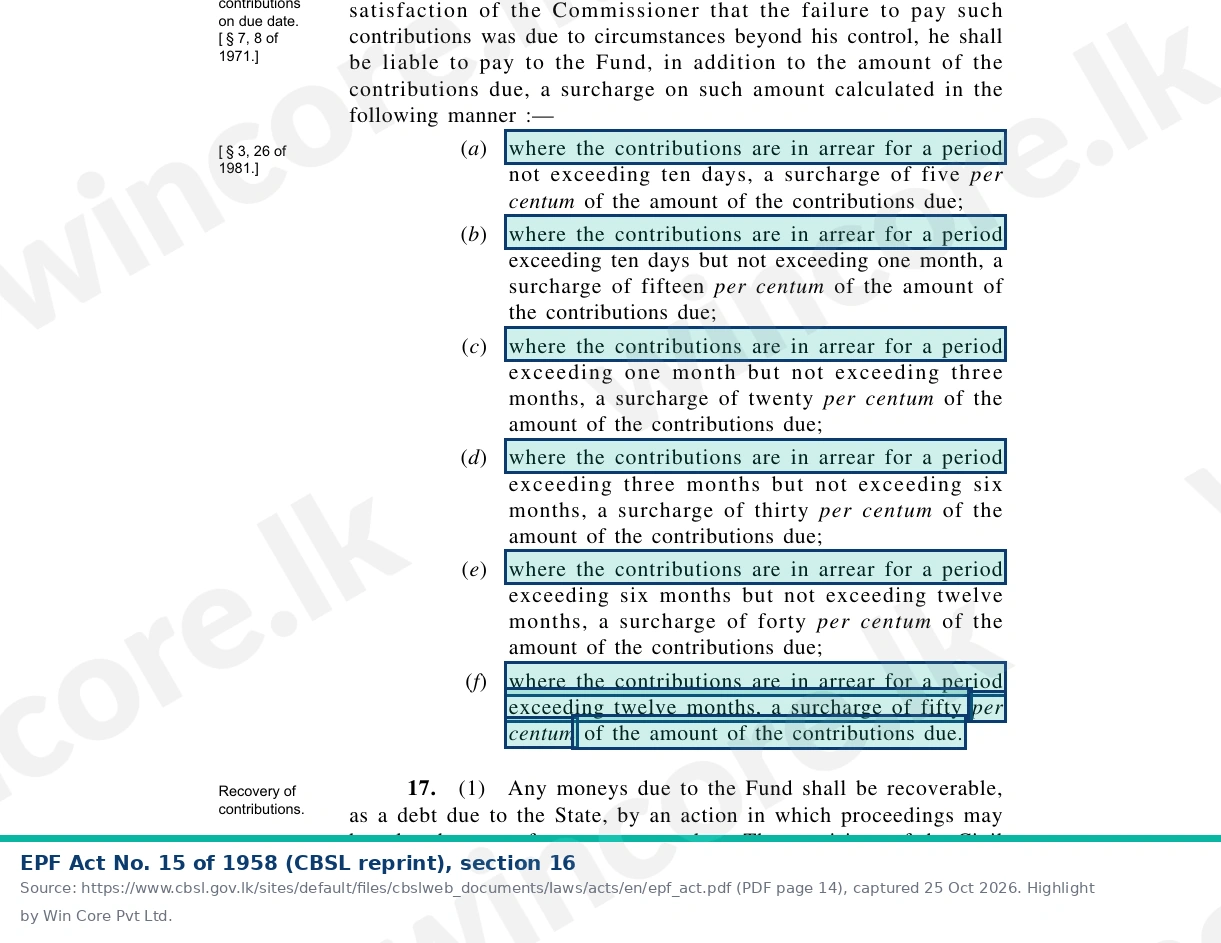
Two more points from the Act matter for old arrears. Section 17(1) makes any moneys due to the Fund "recoverable, as a debt due to the State", and section 17(3) says "The provisions of the Prescription Ordinance shall not apply to the recovery of any sums payable as contributions or surcharges under this Act" [1]. Old arrears do not expire with time.
We checked the 2024 consolidation of the EPF Act, which lists amending Acts up to No. 23 of 2021. That last Act amends only the definitions in section 47, for detached international workers [8]. Neither Act No. 2 of 2012 nor Act No. 23 of 2021 touches sections 10, 15, 16, 17, 19 or 20, and the 2024 consolidation prints them as in the CBSL reprint [2] [9]. Section 31A, already in the reprint at one per centum, imposes a surcharge for every completed month or part of a month where a required return is late, incorrect or deficient; section 5 of Act No. 2 of 2012 substituted the words "at the rate of two per centum", and section 6 inserted section 31B, which requires monthly returns from employers of fifty or more [9].
The ETF Act has no employee share and uses the same 5 to 50 percent surcharge scale
ETF is paid by the employer only. Section 16(1) of the ETF Act makes the employer liable to pay, "on or before the last day of the succeeding month, a contribution of an amount equal to three per centum of the total earnings of such employee" [3]. There is no employee share to recover.
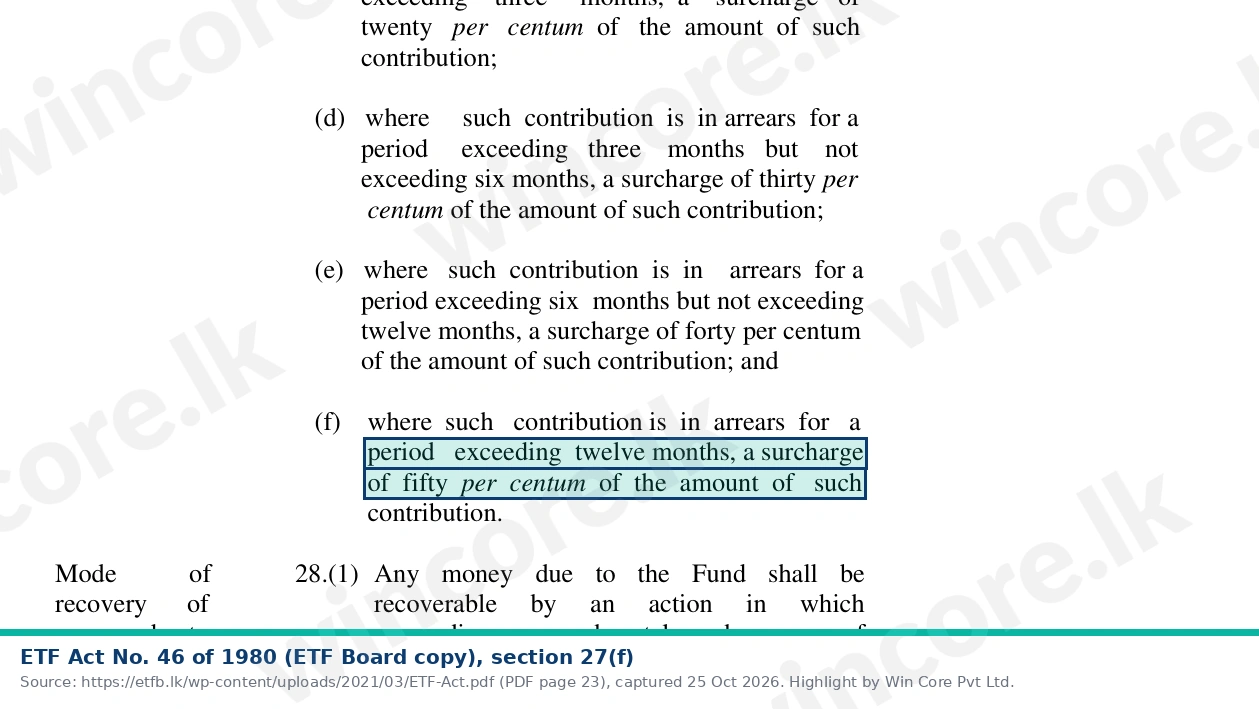
Section 27 applies the same surcharge scale as the EPF Act, from 5 percent for a delay of up to ten days to "a surcharge of fifty per centum of the amount of such contribution" where the contribution is in arrears for more than twelve months [3]. Section 28(6) says "The provisions of the Prescription Ordinance shall not apply to the recovery of any sum payable as contribution or surcharge under this Act." Section 37A, in the Board's copy with amendments to 1993, adds a surcharge of "one per cent of the amount of the contribution to which the return relates for every completed month or part thereof" for late, incorrect or deficient returns. The ETF Board's April 2026 notice describes it as 1 percent "of the relevant contribution for every completed month or part thereof, calculated from the due date" [7].
The ETF Board's list of amending Acts ends with Act No. 18 of 1993 and the Special Provisions Act No. 19 of 1993 [6].
The EPF Act does not say whether the employer can recover the employee's missed 8 percent
The first question is whether the missed employee share can be taken back from later pay.
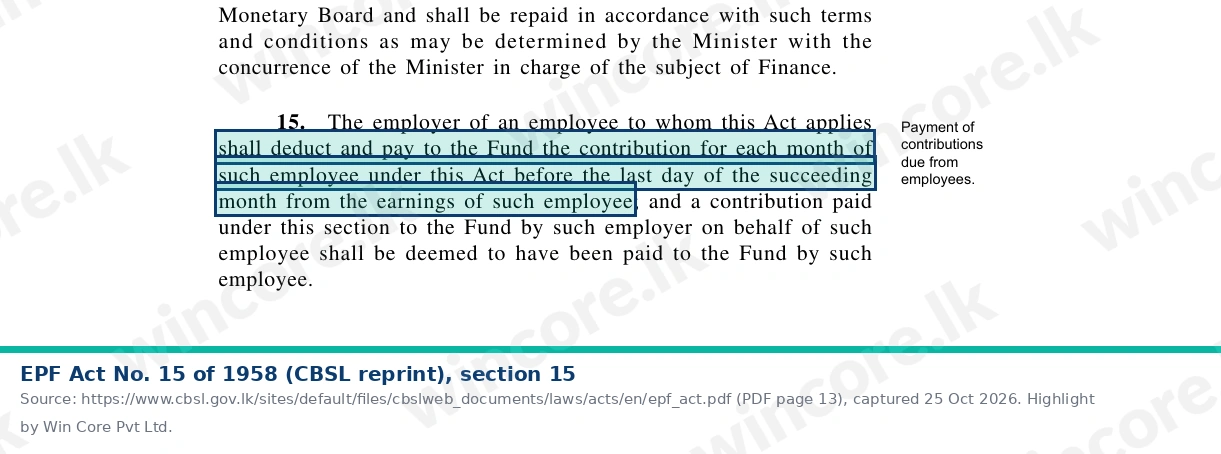
Section 15 of the EPF Act says the employer "shall deduct and pay to the Fund the contribution for each month of such employee under this Act before the last day of the succeeding month from the earnings of such employee" [1].
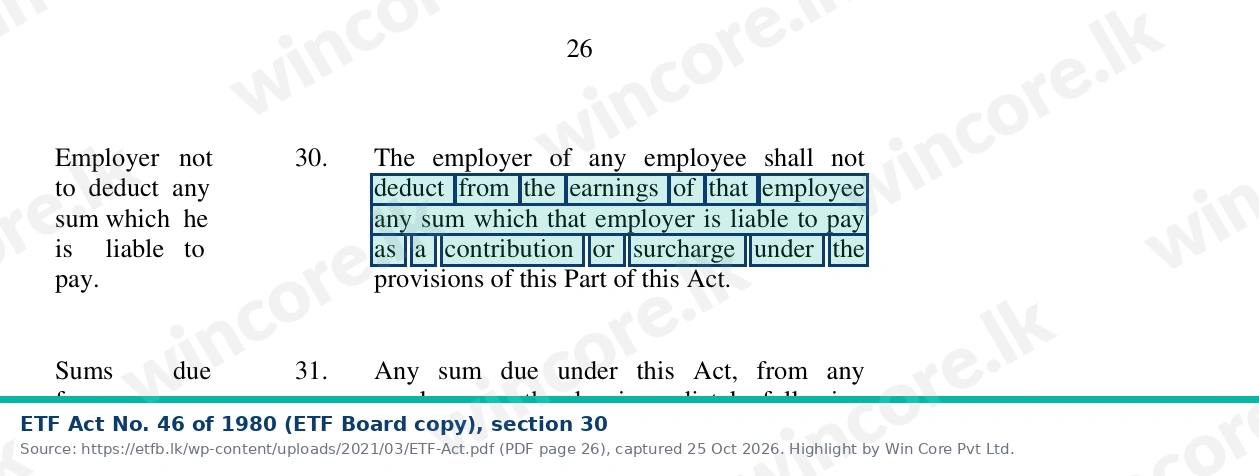
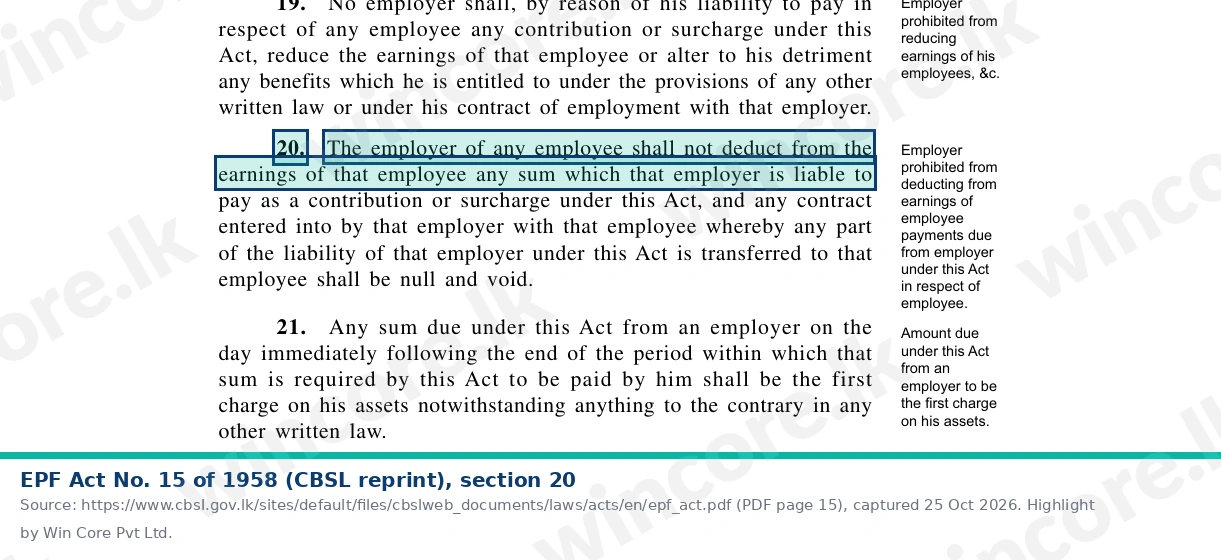
Section 20 then says: "The employer of any employee shall not deduct from the earnings of that employee any sum which that employer is liable to pay as a contribution or surcharge under this Act, and any contract entered into by that employer with that employee whereby any part of the liability of that employer under this Act is transferred to that employee shall be null and void" [1]. ETF Act section 30 has the same bar for ETF, without the contract limb: the employer "shall not deduct from the earnings of that employee any sum which that employer is liable to pay as a contribution or surcharge under the provisions of this Part of this Act" [3].
Put plainly:
- The 12 percent employer share, the 3 percent ETF and every surcharge cannot be taken from the employee's pay. Section 20 forbids it, and any agreement to shift them is void.
- The 8 percent employee share for past months. The Act does not answer this in terms. Section 15 requires the employer to deduct each month's contribution "from the earnings of such employee" and pay it "before the last day of the succeeding month"; it says nothing about a later catch-up deduction, and the employer that missed the deduction still has to pay the full contribution to the Fund. Section 20 bars deducting any sum the employer "is liable to pay as a contribution or surcharge" and voids any contract that transfers part of the employer's liability to the employee, but it does not say whether a missed employee share becomes such a sum. We treat recovery as an open point: do not deduct without the employee's written agreement and advice from a labour lawyer, and never reduce earnings in breach of section 19.
- The EPF Department's view on responsibility. Its employer FAQ says "The employer is not absolved from this responsibility even on the ground of the employee's unwillingness to contribute for EPF" [4].
Plan to carry the full 20 percent of the missed months, plus surcharge, as the company's own cost unless a lawyer confirms a lawful way to recover the employee share.
Pay arrears with a separate form for each month
EPF (Central Bank EPF Department). The EPF Department's employer FAQ says employers "are liable to pay late contributions directly to the Central Bank along with the late surcharges imposed by Labor Department" [4]. Where the arrears come from Labour Department action, the FAQ says "Delayed contributions & surcharges imposed by the Red notice/notices/actions taken by the Labour Department and contributions & surcharges calculated as a result of court decisions should be paid through Labour Department" [4].
Each payment goes with a completed Form C showing each member's share. The FAQ notes that "Three copies should be prepared. The original copy of the Form "C" should be submitted to the EPF Department of CBSL and the second copy should be forwarded to the nearest Labour Office" [4]. The blank Form C is on the EPF Department's employer forms page [5]. In practice, prepare one Form C per arrears month, so each month's contribution is credited to the right period; the FAQ does not say this in terms.
ETF (ETF Board). The ETF Board's payment page says "A separate remittance form should be used for each month in respect of payments of arrears. If not so, please attach a separate schedule indicating the breakdown of the total amount" [6]. The same page puts employers "having 15 or more employees" in the larger category, but also says those "who have more than 15 employees must use the R1 Remittance Form and employers who have less than 15 employees may use the R4 Remittance Form", which leaves an employer of exactly 15 unclear on forms [6]. The regulation settles the electronic rule: Gazette Extraordinary No. 2311/39 of 22 December 2022, made under section 43 of the ETF Act, requires every employer with "a minimum of fifteen employees" to pay contributions and furnish monthly returns electronically from 1 February 2023, and the Board's April 2026 notice says that from July 2026 contributions (due by 31 August 2026) it will not accept cheque, money order, cash or manual returns from them [7]. The wholesaler, with 12 warehouse staff and four office staff, has 16 employees, so it pays its ETF arrears electronically, entering the surcharge notice number where it pays a surcharge [6].
Our monthly EPF and ETF payment guide and EPF and ETF surcharge guide cover the routine steps.
A short payment is corrected with an accurate Form C, the shortfall and a surcharge
An underpayment is a contribution paid short, for example on a base that left out an allowance. The EPF FAQ says "When the amount paid is less than the calculated contribution, a surcharge will be added according to the number of days from the under payment to the full payment" [4]. When the Department writes about a mismatch, "Employers are responsible to provide accurate Form "C" and pay the shortfalls if any and 2% surcharge" [4].
If the employer paid too much, the FAQ allows the excess to be set off against later payments or refunded through "Form "Q" through the Commissioner of Labour within one year of the payment" [4]. If you think a surcharge was wrongly charged, see our guide on appealing an EPF surcharge.
Worked example: two storekeepers missed for six months cost Rs 308,430 by 20 November
Two storekeepers, among the wholesaler's 12 warehouse staff, joined on 1 April 2026 at Rs 90,000 a month total earnings each. Payroll leaves them off Form C and the ETF return from April to September 2026. The company finds the gap in November and pays all arrears on 20 November 2026.
| Item per month (two storekeepers) | Rupees |
|---|---|
| Employee share, 8% of Rs 180,000 | 14,400 |
| Employer share, 12% of Rs 180,000 | 21,600 |
| EPF total | 36,000 |
| ETF, 3% of Rs 180,000 | 5,400 |
Our EPF calculator gives each month's 8, 12 and 3 percent. Each month's contribution was due by the last day of the next month. Counting from that day to 20 November 2026, on our reading of the section 16 and section 27 bands:
| Month | Due by | Delay to 20 Nov | Rate | EPF surcharge | ETF surcharge |
|---|---|---|---|---|---|
| April | 31 May | About 5 months 20 days | 30% | 10,800 | 1,620 |
| May | 30 June | About 4 months 20 days | 30% | 10,800 | 1,620 |
| June | 31 July | About 3 months 20 days | 30% | 10,800 | 1,620 |
| July | 31 August | About 2 months 20 days | 20% | 7,200 | 1,080 |
| August | 30 September | About 1 month 20 days | 20% | 7,200 | 1,080 |
| September | 31 October | 20 days | 15% | 5,400 | 810 |
| Total | 52,200 | 7,830 |
Total cash out: EPF contributions Rs 216,000, EPF surcharge Rs 52,200, ETF Rs 32,400 and ETF surcharge Rs 7,830, a total of Rs 308,430. Of the Rs 216,000 EPF, Rs 86,400 is the storekeepers' 8 percent share for those months. The EPF Department or the Labour Department computes the surcharge it actually charges, so treat these figures as an estimate.
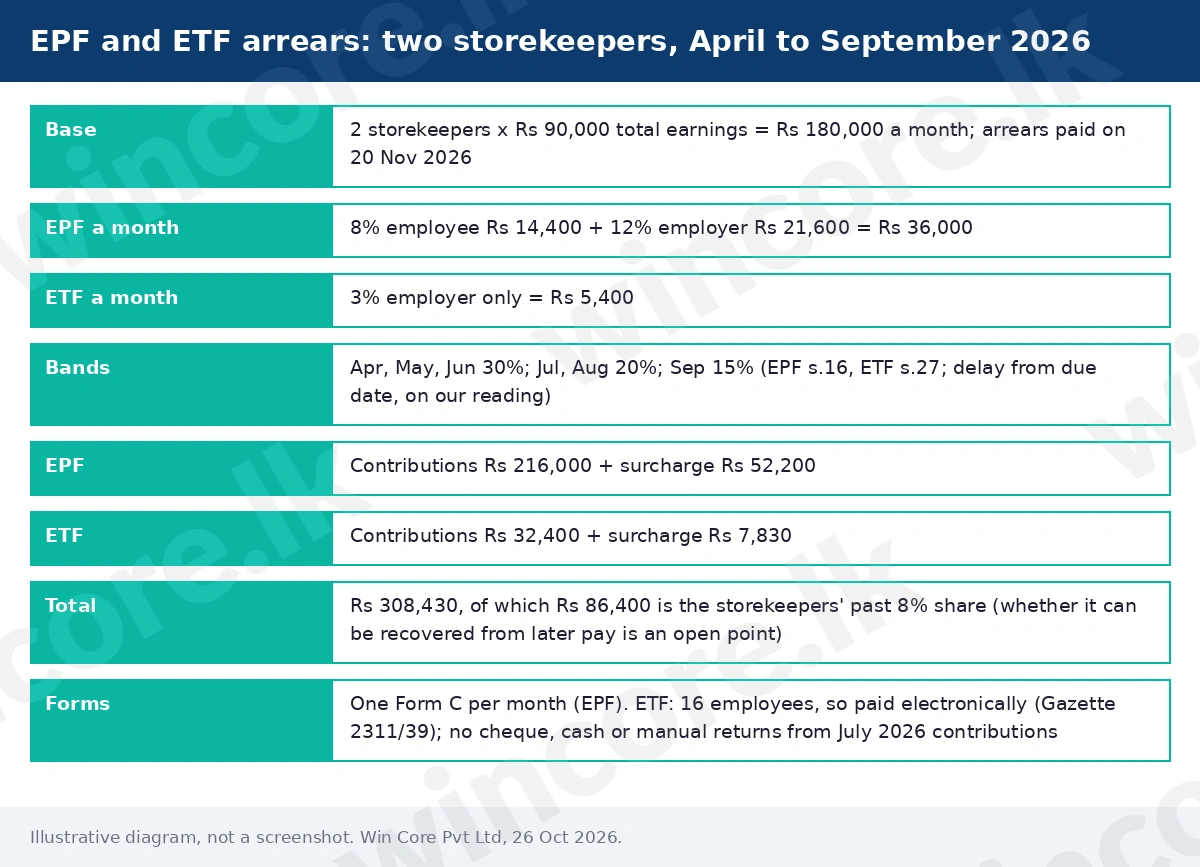
The rate steps up at each band edge, so every month of delay can move one or more months into a higher band. Pay as soon as the gap is found.
What this means for you
Arrears do not go away with time, and the surcharge climbs to 50 percent after a year. Find the gap, pay each month on its own form and expect to carry the full cost, including the missed employee share, unless a lawyer confirms a lawful way to recover it.
Checklist: documents needed
- List every employee and month affected, with total earnings for each month.
- Work out the 8 percent, 12 percent and 3 percent for each month.
- Work out the surcharge band for each month from its due date.
- Prepare one Form C per month for EPF; for ETF, pay electronically if you employ fifteen or more, otherwise use one R1 or R4 per month or one form with a monthly schedule.
- Pay EPF to the Central Bank, or through the Labour Department if it has issued a notice.
- Do not deduct the 12 percent, the ETF or any surcharge from pay (EPF s.20, ETF s.30).
- Take legal advice before any recovery of the past 8 percent.
- Fix the payroll setting that caused the gap, and reconcile payroll to the EPF and ETF returns every month.
FAQ
Can I deduct the employee's missed 8 percent from next month's salary?
The EPF Act does not say so in terms. Section 15 requires each month's 8 percent to be deducted and paid by the end of the following month, and section 20 bars deducting any sum the employer is liable to pay as a contribution or surcharge. Whether that bar reaches a missed employee share is open, so do not deduct without the employee's written agreement and legal advice.
What is the surcharge on EPF arrears in Sri Lanka?
Section 16 of the EPF Act sets it by delay: 5 percent up to ten days, 15 percent up to one month, 20 percent up to three months, 30 percent up to six months, 40 percent up to twelve months and 50 percent beyond. ETF Act section 27 uses the same bands. The surcharge is charged on the contribution due.
Do old EPF arrears become time-barred?
No. EPF Act section 17(3) says the Prescription Ordinance does not apply to the recovery of contributions or surcharges, and ETF Act section 28(6) says the same for ETF. Old EPF arrears stay recoverable as a debt due to the State (EPF s.17(1)), and ETF arrears by summary action (ETF s.28(1)), so it is better to clear them than to wait for a Labour Department notice.
Is there an employee share for ETF arrears?
No. ETF Act section 16(1) places the 3 percent contribution on the employer alone, and section 30 forbids deducting it from the employee's earnings. When ETF arrears are paid, the employer bears the whole contribution and any section 27 surcharge. An employer of fifteen or more pays electronically; on a manual payment, use a separate R1 or R4 form for each month or attach a monthly schedule.
Free download: the EPF & ETF Record-Keeping Audit Checklist (Sri Lanka) (PDF).
Talk to us. If you have EPF or ETF arrears to clear or surcharges to check, see our payroll services.
WinCore Pvt Ltd
This article is general information as at 26 October 2026 and is not legal or payroll advice on your specific position.
Sources and references (11)
- Parliament of Sri Lanka. Employees' Provident Fund Act, No. 15 of 1958, CBSL reprint incorporating amendments to 31 December 1998, ss.10, 15, 16, 17, 19, 20. https://www.cbsl.gov.lk/sites/default/files/cbslweb_documents/laws/acts/en/epf_act.pdf . Primary. Accessed 25 October 2026.
- Employees' Provident Fund Act, consolidated 2024 (unofficial, lankalaw.net), listing Acts to No. 23 of 2021; s.31A as inserted by Act No. 2 of 2012. https://lankalaw.net/wp-content/uploads/2025/03/Employees-Provident-Fund-Consolidated-2024.pdf . Secondary. Accessed 25 October 2026.
- Parliament of Sri Lanka. Employees' Trust Fund Act, No. 46 of 1980, ETF Board copy with Acts No. 3 of 1982, 47 of 1988, 18 and 19 of 1993, ss.16, 27, 28, 29, 30. https://etfb.lk/wp-content/uploads/2021/03/ETF-Act.pdf . Primary. Accessed 25 October 2026.
- Employees' Provident Fund Department, Central Bank of Sri Lanka. FAQs for Employers. https://epf.lk/?page_id=811 . Primary. Accessed 25 October 2026.
- Employees' Provident Fund Department. Forms Related to Employers. https://epf.lk/?page_id=749 . Primary. Accessed 25 October 2026.
- Employees' Trust Fund Board. Payment of Contributions and Welcome (ETF Act and amendments). https://etfb.lk/payment-of-contributions/ and https://etfb.lk/welcome/ . Primary. Accessed 25 October 2026.
- Employees' Trust Fund Board. Notice: Mandatory Electronic Payment of Contributions and Submission of Monthly Returns (April 2026). https://etfb.lk/wp-content/uploads/2026/04/NOTICE-Mandatory-Electronic-Payment-English.pdf ; Gazette Extraordinary No. 2311/39 of 22 December 2022, regulations under section 43 inserting regulation 3(1)(c) and (d), as published by the Board: https://etfb.lk/wp-content/uploads/2026/04/English-Already-exist-in-the-Website.pdf . Primary. Accessed 26 October 2026.
- Parliament of Sri Lanka. Employees' Provident Fund (Amendment) Act, No. 23 of 2021 (certified 13 October 2021), s.2 (amends s.47). https://www.parliament.lk/uploads/acts/gbills/english/6226.pdf . Primary. Accessed 26 October 2026.
- Parliament of Sri Lanka. Employees' Provident Fund (Amendment) Act, No. 2 of 2012 (certified 9 February 2012), ss.5 and 6 (s.31A rate, new s.31B). https://www.cbsl.gov.lk/sites/default/files/cbslweb_documents/laws/acts/en/epf_act_2_2012_e.pdf . Primary. Accessed 26 October 2026.
Put these insights to work
WinCore specialists can review your current workflow, document gaps, and build a practical 90-day action plan.
Book a free consultationRecent articles




Continue reading
Explore more WinCore analysis to keep your finance, tax, and compliance roadmap moving.
Registered with the Department of Labour months after the first hire? What is owed for each past month, the surcharge step, and why it never time-bars.
The four sections behind EPF and ETF: rates, the due day, the 5 to 50 percent ladder, who judges 'beyond control', and what Act No. 2 of 2012 changed.
Got an EPF or ETF surcharge notice? Where you can challenge it, the 30-day ETF clock, what to keep on file, and how the disputed amount is shown.