
Employee IP ownership Sri Lanka: contracts and NDAs for tech teams
Who owns the code your staff and freelancers write, how moral rights and inventions work, and what an NDA must be backed by under the IP Act.
On this page
Last verified against the primary sources on 22 October 2026.
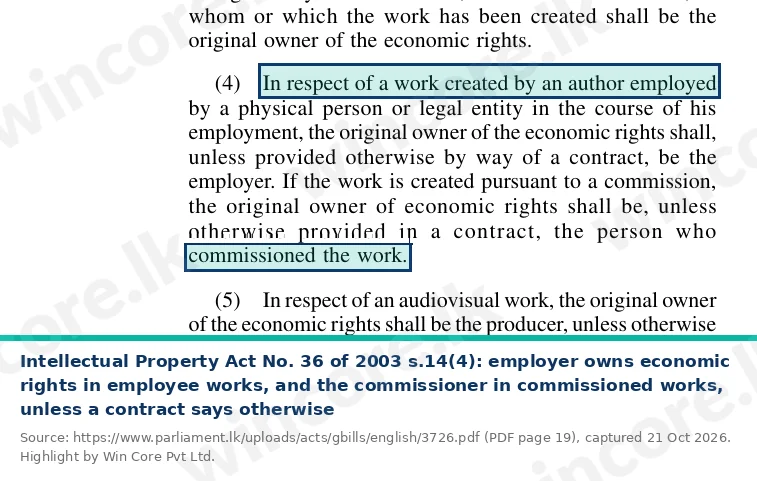
Employee IP ownership in Sri Lanka starts with section 14(4) of the Intellectual Property Act No. 36 of 2003: for a work an employee creates "in the course of his employment", the employer is the original owner of the economic rights "unless provided otherwise by way of a contract", and for a commissioned work the owner is "the person who commissioned the work" [1]. Computer programs are protected works under s.6(1)(a) [1]. Patentable inventions follow s.69, which gives the employer the patent right but keeps the inventor's right to equitable remuneration, which "shall not be restricted by contract" [1]. Confidential know-how is protected as "undisclosed information" under s.160(6), and wilful disclosure of it is an offence under s.160(8) [1].
This article sets out those rules clause by clause, what an employment contract and an NDA for a tech team should do with them, and which points, such as non-competes, are not settled by the Act. It is general information, not legal advice on any particular contract.
Code is a protected work under section 6(1)(a)
Section 6(1)(a) protects as works "books, pamphlets, articles, computer programs and other writings" [1]. Section 5 defines a "computer program" as "a set of instructions expressed in words, codes, schemes or in any other form, which is capable, when incorporated in a medium that the computer can read, of causing a computer to perform or achieve a particular task or result" [1]. On our reading, source code, scripts and configuration written by a team member are works, and the ownership rules in s.14 decide who holds the economic rights in them.
The Act has been amended by Acts No. 7 of 2018, No. 8 of 2021 and No. 8 of 2022 [2] [3]. In the LankaLAW consolidation to 2024, the provisions quoted in this article read as in the 2003 text [1] [2].
Employee IP ownership in Sri Lanka follows section 14(4) unless the contract changes it
The starting point in s.14(1) is that "the author who created the work shall be the original owner of economic rights", subject to subsections (2) to (5) [1]. Subsection (4) then sets the employment and commission rules:
"In respect of a work created by an author employed by a physical person or legal entity in the course of his employment, the original owner of the economic rights shall, unless provided otherwise by way of a contract, be the employer. If the work is created pursuant to a commission, the original owner of economic rights shall be, unless otherwise provided in a contract, the person who commissioned the work." [1]
Three points follow, on our reading:
- "In the course of his employment" is not defined. Code written for the employer's product during the job is plainly inside it. A weekend project on the engineer's own laptop may not be. The contract should describe the role and the kinds of work it covers, so the boundary is written down.
- The rule can be varied either way. "Unless provided otherwise by way of a contract" lets a contract give rights back to the employee as well as confirm them for the employer. A loose side-project or open-source clause can do that by accident.
- It covers economic rights only. Moral rights are separate and stay with the author (see below).
Freelancers and agencies: the commission rule, prior material and signed assignments
The second sentence of s.14(4) gives a business that commissions code, designs or content the economic rights by default, "unless otherwise provided in a contract" [1]. Two cautions:
- Prior material. A contractor often brings libraries, templates or components built before the engagement. Those were not created "pursuant to a commission" from you, so on our reading the contract should license them to you or list them as excluded.
- The contractor's own terms. Agency terms often keep ownership until payment, or outright. That is "otherwise provided in a contract", and it overrides the default.
Where you need to take over rights that already exist, s.16(2) says "Any assignment or transfer of an economic right, and any licence to do such an act subject to authorization by the owner of the copyright, shall be in writing signed by the assignor and the assignee" [1]. Section 16(3) adds that an assignment "shall not include or be deemed to include" any rights "not expressly referred to therein" [1]. On that wording, an email or an unsigned statement of work does not transfer existing rights, and a signed assignment should list the rights it covers.
Whether a person is a contractor or an employee also decides tax, EPF and ETF treatment; our article on consultant or employee misclassification covers that side.
Moral rights stay with the author unless waived in specific writing
Section 10(1) gives the author, "independently of his economic rights and even where he is no longer the owner of those economic rights", the right to be named, to use a pseudonym, and "to object to any distortion, mutilation or other modification of, or other derogatory action in relation to, his work which would be prejudicial to his honour or reputation" [1]. Section 10(2) says no moral right "shall be transmissible during the life time of the author" [1].
They can be waived, but only in a particular form. Section 10(3): "The author may waive any of the moral rights mentioned in subsection (1), provided that such a waiver is in writing and clearly specifies the right or rights waived and the circumstances to which the waiver applies" [1]. A one-line waiver of "all moral rights" may not meet "clearly specifies" on our reading. A waiver that names each right (attribution, pseudonym, objection to modification) and the circumstances (modifying, combining and releasing the code in the employer's products without naming the author) is closer to the words.
Inventions follow section 69, and the remuneration right cannot be contracted out
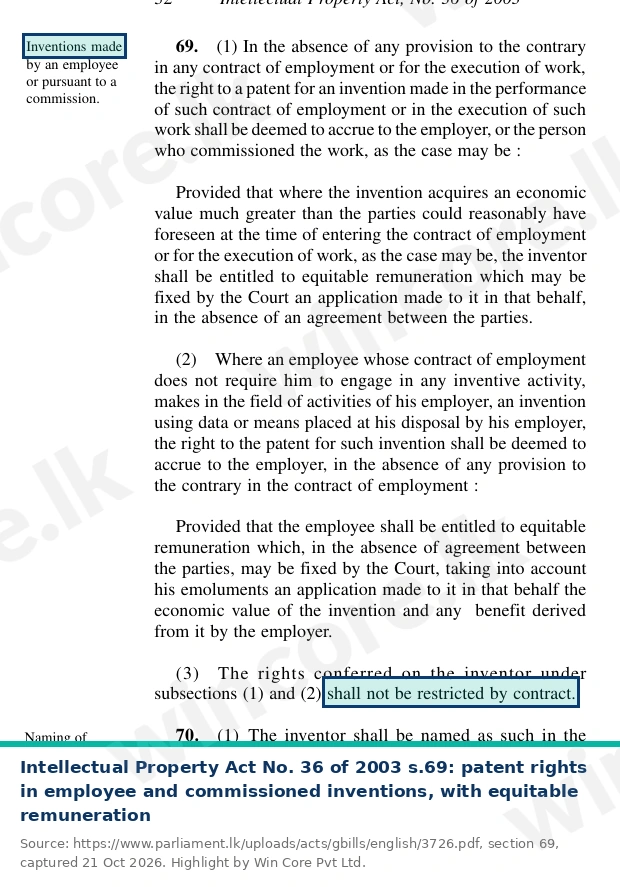
For a patentable invention, s.69(1) says: "In the absence of any provision to the contrary in any contract of employment or for the execution of work, the right to a patent for an invention made in the performance of such contract of employment or in the execution of such work shall be deemed to accrue to the employer, or the person who commissioned the work, as the case may be" [1]. Two protections for the inventor follow:
- Unexpected value. Where the invention "acquires an economic value much greater than the parties could reasonably have foreseen", the inventor "shall be entitled to equitable remuneration", fixed by the Court if the parties do not agree (s.69(1) proviso) [1].
- Inventions outside the job description. Where an employee whose contract "does not require him to engage in any inventive activity" makes an invention in the employer's field "using data or means placed at his disposal by his employer", the patent right goes to the employer, but the employee is entitled to equitable remuneration (s.69(2)) [1].
Section 69(3) then says: "The rights conferred on the inventor under subsections (1) and (2) shall not be restricted by contract." [1] So a clause in which an employee gives up any claim to equitable remuneration does not, on that wording, remove those rights. Section 34 applies the same structure to industrial designs created by employees [1].
An NDA is evidence of the reasonable steps that section 160 requires
The Act treats misuse of confidential business information as unfair competition. Section 160(6)(a) covers any act or practice "that results in the disclosure, acquisition or use by others, of undisclosed information without the consent of the person lawfully in control of that information ... and in a manner contrary to honest commercial practices" [1]. Section 160(6)(b) lists ways this happens, including "breach of contract" and "breach of confidence" [1].
Under s.160(6)(c), information is "undisclosed information" only if [1]:
- it is not "generally known among, or readily accessible to, persons within the circles that normally deal with the kind of information in question";
- "it has actual or potential commercial value because it is secret"; and
- "it has been subject to reasonable steps under the circumstances by the rightful holder to keep it secret".
Section 160(6)(e) says it includes "technical information related to the manufacture of goods or the provision of services" and "business information which includes the internal information which an enterprise has developed so as to be used within the enterprise" [1]. On our reading, unreleased source code, model weights, pricing logic and client lists can all qualify.
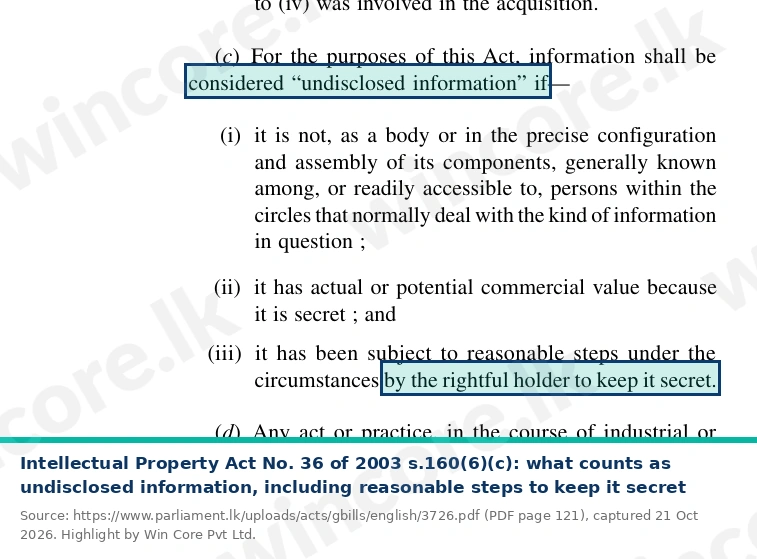
The third condition is where an NDA earns its place. On our reading, a signed confidentiality clause, access controls and a record of who saw what are all evidence of "reasonable steps". An NDA sitting beside shared passwords and public repositories is weak evidence.
The consequences are civil and criminal. Under s.160(7) a person aggrieved "may institute proceedings in Court to prohibit the continuance of such act or practice and obtain damages" [1]. Under s.160(8)(a), "Any person, who willfully and without lawful authority, discloses any undisclosed information shall be guilty of an offence" and is liable to "a fine not exceeding five hundred thousand rupees or to imprisonment for a term not exceeding six months or to both" [1].
Personal data in the team's hands is a separate regime. Parts I and III of the Personal Data Protection Act apply from 1 January 2027, and a processor must then bind its staff to confidentiality, as our PDPA obligations article explains. An NDA supports those duties but does not replace them.
Non-competes and non-solicits are not settled by the Act
Many tech contracts restrict a leaver from joining a competitor for a period, or from approaching clients or staff. The Intellectual Property Act does not deal with post-employment restraints, and we found no provision on them in the texts read for this article. Their enforceability in Sri Lanka turns on case law on restraint of trade, which we have not reviewed for this piece.
So we do not say whether any given restraint would be enforced. What the Act does give an employer is ownership of work made in the job (s.14(4) and s.69) and protection for information kept secret (s.160). Those are the clauses with a statutory footing. A restraint is a question for a lawyer on the specific wording, and we list it as an open point.
A hypothetical example: two founders, one developer, one design agency
The following is hypothetical. Two founders incorporate a company that sells a Sinhala-language learning app. Before incorporation they wrote the first version themselves. The company then hires one developer on a signed employment contract and engages a small design agency by email.
- Developer's code. Written in the course of employment, so the company owns the economic rights under s.14(4), unless the contract says otherwise.
- Agency's screens. Created pursuant to a commission, so on our reading the company owns the economic rights under s.14(4), unless the agency's terms say otherwise. Moral rights stay with the individual designers who are the authors unless waived in writing that meets s.10(3).
- Founders' pre-incorporation code. Written before the company existed, so neither the employment nor the commission rule applies. On our reading the company needs a signed written assignment under s.16(2) that names the rights transferred (s.16(3)). As practice, the board should minute the assignment where the founders are also directors; our company secretarial services keep those minutes and registers.
What this means for you
- Confirm the s.14(4) default in every employment contract, with a role description wide enough to show what is "in the course of his employment", and no accidental carve-backs.
- Take signed written assignments for anything outside the defaults: founders' early code, contractors' prior work, and any agency that reserves ownership.
- Get moral rights waivers that name the rights and the circumstances (s.10(3)).
- Do not try to contract out of s.69 remuneration. Acknowledge it in an invention disclosure clause instead.
- Back NDAs with real controls so the "reasonable steps" limb of s.160(6)(c) can be shown, and collect devices and access on exit; our employee termination guide covers the leaver process.
- Treat non-competes as unsettled. Our HR compliance services review employment contracts and leaver checklists; for a restraint clause or a patent assignment, take a lawyer's view.
Checklist: documents needed
- Signed employment contracts with role descriptions and the IP clause
- Contractor and agency agreements, including their standard terms
- Signed written assignments for founders' and contractors' prior work, listing the rights
- Written moral rights waivers naming the rights and circumstances
- Invention disclosure records
- NDAs and the confidentiality policy
- Access control lists for repositories and data
- Leaver checklists showing return of devices, code and data
FAQ
Who owns code written by an employee in Sri Lanka?
The employer, if the code was written in the course of the employee's employment, unless the contract provides otherwise, under section 14(4) of the Intellectual Property Act. The Act does not define "in the course of his employment", so a contract that describes the role and the work it covers is the best evidence of where the boundary sits.
Does a freelancer own the code until we pay?
Not by default, because section 14(4) makes the person who commissioned a work its original owner unless a contract provides otherwise. Many freelancer and agency terms do provide otherwise, for example by keeping ownership until payment. Read their terms, and take a signed written assignment under section 16(2) for anything they built before the engagement.
Can an employee waive moral rights in advance?
Yes, but only in writing that clearly specifies the rights waived and the circumstances, under section 10(3). A general sentence waiving all moral rights may not meet that test on our reading. Name each right, such as attribution and objection to modification, and describe the uses, such as modifying and releasing the code without credit.
Is a non-compete clause enforceable in Sri Lanka?
We do not state an answer, because the Intellectual Property Act does not deal with restraints and enforceability turns on restraint of trade case law we have not reviewed. The safer ground is the Act's own protection: ownership of work made in the job under sections 14(4) and 69, and protection of secret information under section 160.
Does an NDA alone protect our source code?
It helps, but section 160(6)(c) asks whether reasonable steps were taken to keep the information secret, so an NDA should sit with access controls and records. If the code qualifies, wrongful use can be stopped through the courts under section 160(7), and wilful disclosure without lawful authority is an offence under section 160(8).
Open points
- Restraint of trade. Enforceability of non-competes and non-solicits depends on case law not reviewed for this article.
- "In the course of his employment." Not defined in the Act; no judgment read.
- Termination of Employment of Workmen Act. Not reviewed for its effect on restraints.
- Software patentability and open-source licence terms are outside this article.
- Section 160 amendments. Act No. 8 of 2022 amended section 160 [3]; the consolidation to 2024 shows subsections (6) to (8) unchanged, but we did not read the amending Act itself.
Talk to us. If you want your employment contracts, NDAs and leaver process for a tech team reviewed, speak to us at our contact page.
WinCore Pvt Ltd
This article is general information on the law as at 22 October 2026 and is not advice on your specific situation.
References
- Parliament of Sri Lanka. Intellectual Property Act, No. 36 of 2003, ss.5, 6, 10, 14, 16, 34, 69 and 160. https://www.parliament.lk/uploads/acts/gbills/english/3726.pdf . Primary. Accessed 22 October 2026.
- LankaLAW. Intellectual Property Act, Consolidated (2024), incorporating Acts No. 7 of 2018, No. 8 of 2021 and No. 8 of 2022; ss.14, 69 and 160 compared. https://lankalaw.net/wp-content/uploads/2025/03/Intellectual-Property-Consolidated-2024.pdf . Primary text, unofficial consolidation. Accessed 22 October 2026.
- Sri Lanka Law. Act No. 8 of 2022, Intellectual Property (Amendment) Act, bulletin listing the sections amended. https://www.srilankalaw.lk/bulletin/bulletin-2022/3248-act-8-of-2022-intellectual-property-amendment-act.html . Secondary. Accessed 22 October 2026.
Put these insights to work
WinCore specialists can review your current workflow, document gaps, and build a practical 90-day action plan.
Book a free consultationContinue reading
Explore more WinCore analysis to keep your finance, tax, and compliance roadmap moving.
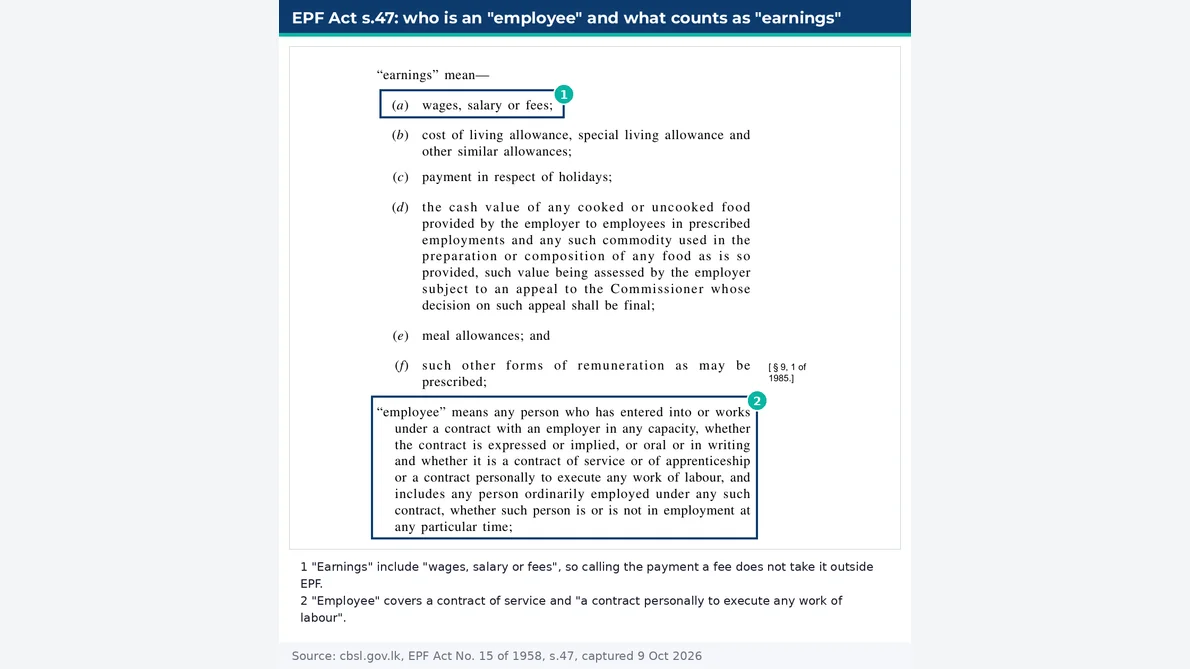
When a consultant is legally an employee in Sri Lanka: the tests under EPF, ETF, gratuity and tax law, and what misclassification costs.
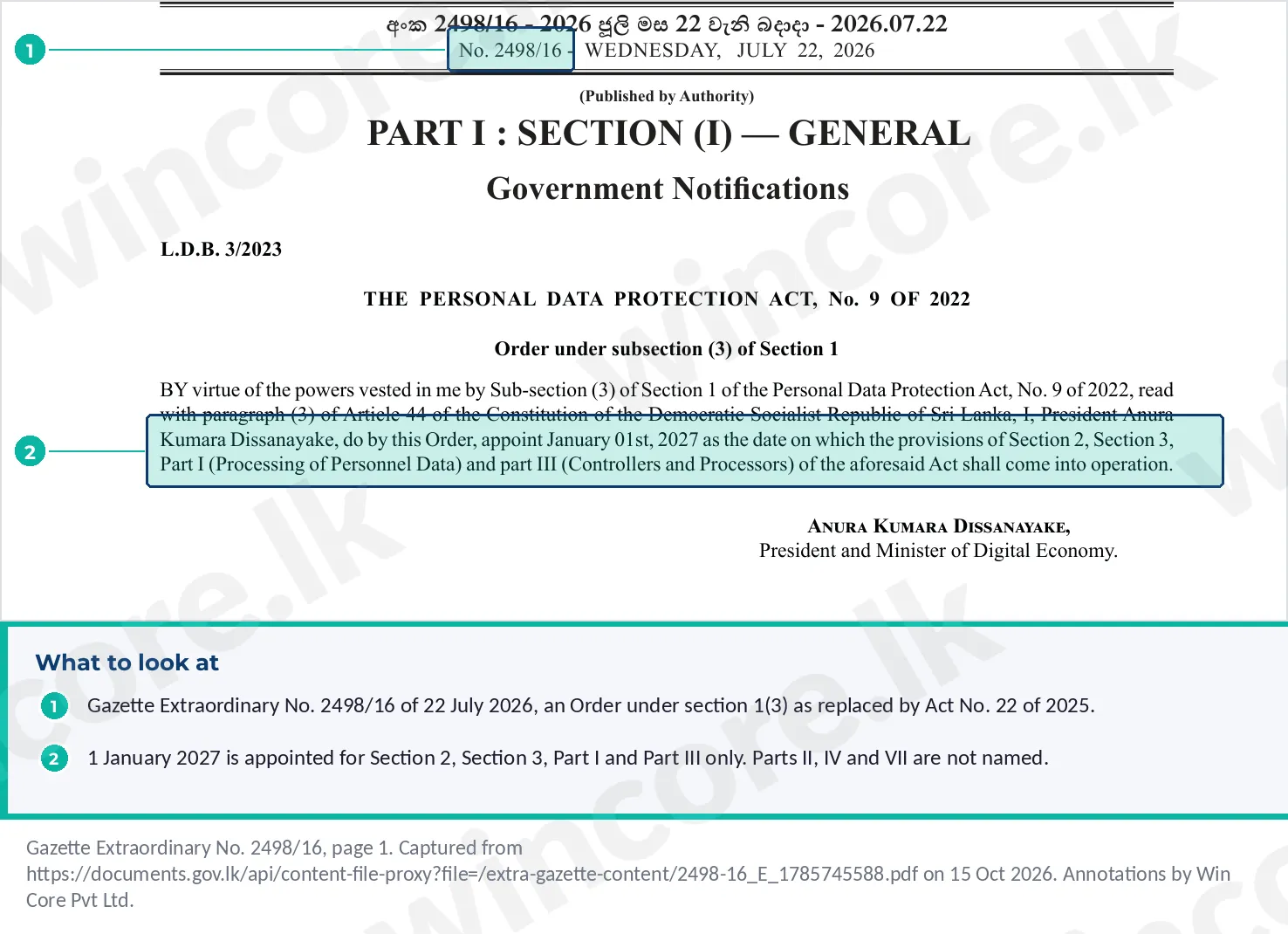
Lawful basis, security, a management programme, processor contracts and breach notice: each PDPA duty that starts in 2027, by section, and what is open.

How to lawfully terminate employees in Sri Lanka: disciplinary inquiries, TEWA consent or approval, compensation, final pay and the six-month tribunal limit.