
IRD assessment appeal Sri Lanka: objection, appeal and time limits
How to answer an IRD assessment: the 30-day objection, the grounds, paying while you object, and the Tax Appeals Commission deadlines and deposit.
On this page
Last verified against the primary sources on 26 October 2026.
Every IRD assessment appeal Sri Lanka taxpayers bring starts with a written objection to the Commissioner-General within thirty days of being notified, with detailed grounds. This is called a request for administrative review under section 139 of the Inland Revenue Act No. 24 of 2017. After the Commissioner-General's decision, or seven months without one, you have thirty days to appeal to the Tax Appeals Commission, and then, on a question of law only, one month to go to the Court of Appeal. The tax stays payable while you object unless the Commissioner-General grants an extension. This guide explains the letters you may receive, how to read one, and every time limit, quoted from the Inland Revenue Act and the Tax Appeals Commission Act No. 23 of 2011 as amended.
The example
A company receives a notice of amended assessment for the year of assessment 2024/25, dated 5 November 2026 and received on 7 November 2026. It shows additional income tax of Rs 1,250,000. The company thinks a deduction was wrongly disallowed. The company, the notice and the figures are invented.
The letters you may receive
| Letter | What it asks of you |
|---|---|
| Reminder or final notice to file | File the missing return or statement |
| Request for information | Provide documents or answers by the date given |
| Notice of assessment (default, amended or additional) | Pay, or object within 30 days |
| Penalty or interest demand | Pay, or object if you dispute the decision |
Reading the letter. Note four things at once: the year of assessment, the tax type, the amount, and the date of the letter and the date you received it. Every deadline below runs from one of those dates. Keep the envelope or email header. Under section 112(4), a notice sent by registered mail to a Sri Lankan address "shall be considered served four days succeeding the day when posted"; on our reading, count the thirty days from whichever is earlier, the day you received it or that deemed date.
A final notice to file
If you have not filed, the Assistant Commissioner may make a default assessment. Section 133(1): where a taxpayer "has failed to file a tax return for a tax period as required under this Act", the Assistant Commissioner may, "to the best of his or her judgement, make an assessment" [1].
Inland Revenue (Amendment) Act No. 11 of 2026 s.31 adds section 185A, in force from 3 June 2026. Where a person fails to file a return under section 93 or a tax return under section 126, among other failures, the Commissioner-General serves notice that proceedings will be instituted "unless he takes necessary steps to comply with the provisions of this Act, within thirty days of serving the notice". Failing to comply "without reasonable cause" is an offence, with a fine "not exceeding four hundred thousand rupees" or up to six months' imprisonment, or both [4]. So file within those thirty days. The late filing penalty under section 178 still applies; see our RAMIS penalties and return filing guides.
If you want to object to a default assessment, section 139(3), as substituted by Act No. 10 of 2021, says the request "shall be sent together with a duly filled return or annual statement" [2].
Object in writing within 30 days: the request for administrative review
Who. Section 139(1): "A taxpayer who is dissatisfied with an assessment or other decision may request the Commissioner-General to review the decision" [1].
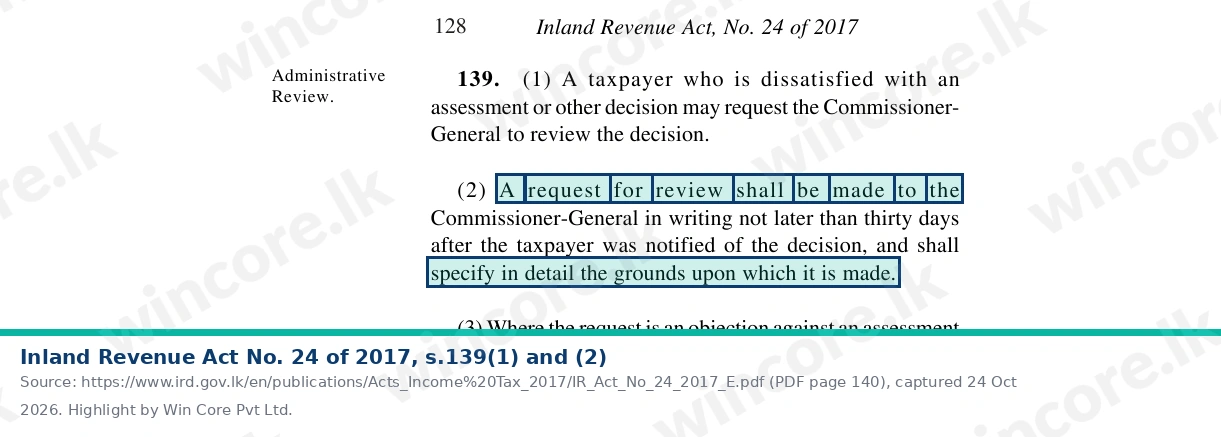
Time limit and form. Section 139(2): the request "shall be made to the Commissioner-General in writing not later than thirty days after the taxpayer was notified of the decision, and shall specify in detail the grounds upon which it is made" [1]. Section 139(8) allows a late request if the taxpayer satisfies the Commissioner-General that "absence from Sri Lanka, sickness, or other reasonable cause" prevented it "and that there has been no unreasonable delay".
Acknowledgement. Section 139(4): receipt "shall be acknowledged within thirty days", and the date of the acknowledgement "shall for the purpose of this section, be deemed to be the date of receipt" [1].
Grounds. "In detail" means each adjustment you dispute, why, and the evidence. In the example: the deduction, the section that allows it, and the invoices and payment proof.
Paying while the objection is open. Section 142: "the tax payable under the assessment shall remain due and payable, unless the Commissioner-General grants an extension of time under section 151 and may be recovered, despite the request for review or appeal" [1]. Objecting does not stop the clock on payment. Ask in writing for an extension under section 151 if you need one. To estimate the late payment penalty and interest on tax paid late, use our penalty calculator.
If you do not object. Section 143(1): "if no request for review is made within the time permitted by section 139, an assessment shall be treated as final" [1]. Section 141 puts the burden of proof on the taxpayer "to show that the assessment is incorrect".
How the Commissioner-General decides
Section 139(5), as substituted by Act No. 10 of 2021 s.42 from 1 April 2021 and amended by Act No. 4 of 2023 s.13 from 8 May 2023:
- The Commissioner-General "shall review the assessment or other decision and notify the taxpayer in writing or by electronics means" of the decision and reasons.
- The request "shall be considered by a tax official other than the tax official who made the assessment or other decision".
- For requests made on or after 8 May 2023, the decision must be notified "within a period of two years from the date on which such request for review is received". If it is not, "the request for review shall be deemed to have been allowed, unless an appeal has been preferred to the Tax Appeals Commission" under section 140(2)(b) [2] [3].
Section 139(6) then gives effect to the decision by confirming, amending (including to nil) or adding to the assessment [1].
Appealing to the Tax Appeals Commission needs a deposit and a petition within 30 days
When you may appeal. Section 140(2): no appeal "unless a request for administrative review has first been made", and either a decision has been received or, as amended by Act No. 10 of 2021 s.43 from 1 April 2021, "seven months have lapsed since the request for administrative review was made" [2].
Time limit. Section 140(5), as substituted by the same Act: a petition of appeal "shall be filed in writing to the Tax Appeals Commission with a copy to the Commissioner-General within thirty days from the date of receipt of the decision of the Commissioner-General or within thirty days from the date on which the period of seven months lapsed since the request for administrative review was made" [2]. Section 140(6) allows a late petition on the same "absence from Sri Lanka, sickness, or other reasonable cause" grounds. The Tax Appeals Commission Act s.7(2) also requires notice to the Commission "within thirty days of the determination being communicated" [5].
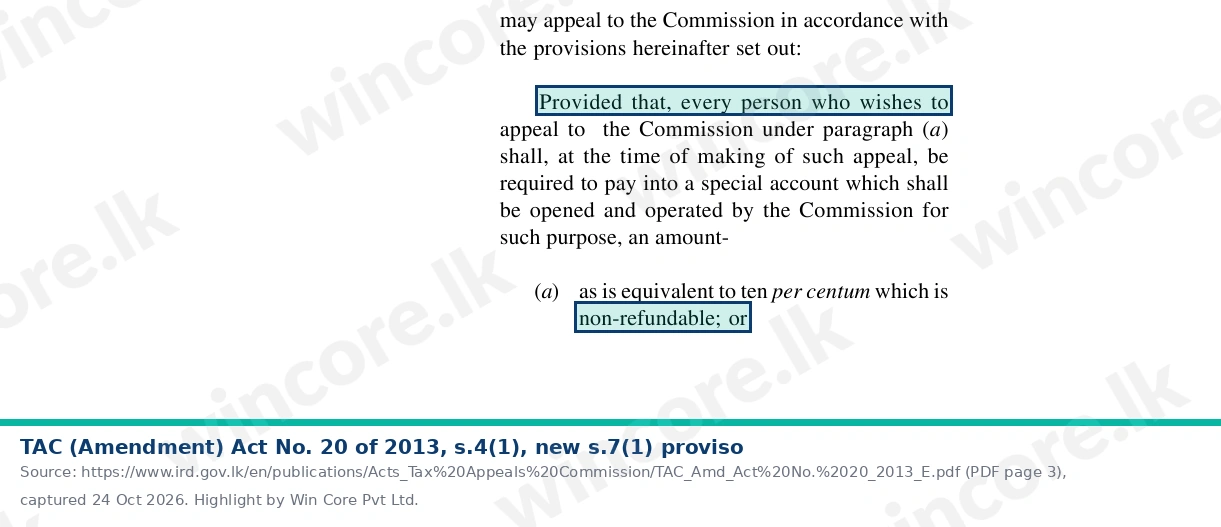
The deposit. Tax Appeals Commission (Amendment) Act No. 20 of 2013 s.4(1) substituted section 7(1) of the Tax Appeals Commission Act. Its proviso requires an appellant against the Commissioner-General, "at the time of making of such appeal", to pay into a special account an amount "(a) as is equivalent to ten per centum which is non-refundable; or (b) as is equivalent to twenty five per centum which is refundable subject to subsection (1A) of this section or a bank guarantee for the equivalent amount which shall remain valid until the appeal is determined by the Commission", in each case "of the sum as assessed by the Commissioner-General as being payable" [6]. The bank guarantee is part of option (b), so it is for 25 percent; there is no guarantee option for the 10 percent payment. New section 7(1A) transfers the amount to the Commissioner-General when the appeal is determined, to be set off against the assessment; any excess of a 25 percent payment may be set off against other taxes, and the balance is refunded on a written request.
In the example, if the Commissioner-General confirms Rs 1,250,000, the deposit is Rs 125,000 non-refundable, or Rs 312,500 refundable, or a bank guarantee for Rs 312,500.
The hearing. Section 9(1), as amended by Act No. 20 of 2013: within thirty days of receiving an appeal the Secretary fixes a hearing "and shall give forty-two days notice thereof". Under section 9(3) the appellant attends "in person or by an authorized representative". Section 9(5) puts the onus on the appellant to prove the assessment "is excessive or erroneous", and section 9(8) bars new documents or witnesses not produced before the Commissioner-General, except with the Commission's consent. All appeals "shall be heard in camera" (s.9(6)). Section 10 requires a determination "within two hundred and seventy days from the date of the commencement of its sittings for the hearing of each such appeal" [5] [6].
The Court of Appeal, on law only
Section 144 of the Inland Revenue Act: either party "may, within one month after being notified of the decision, file a notice of appeal with the Court of Appeal", and section 144(3) says the appeal "shall be made only on a question of law" [1]. The Tax Appeals Commission Act s.11A, inserted by Act No. 20 of 2013 s.8, separately provides for an application to the Commission "to state a case on a question of law for the opinion of the Court of Appeal", made in writing "within one month from the date on which the decision of the Commission was notified", with a fee of "one thousand and five hundred rupees" [5]. Take legal advice on which route applies.
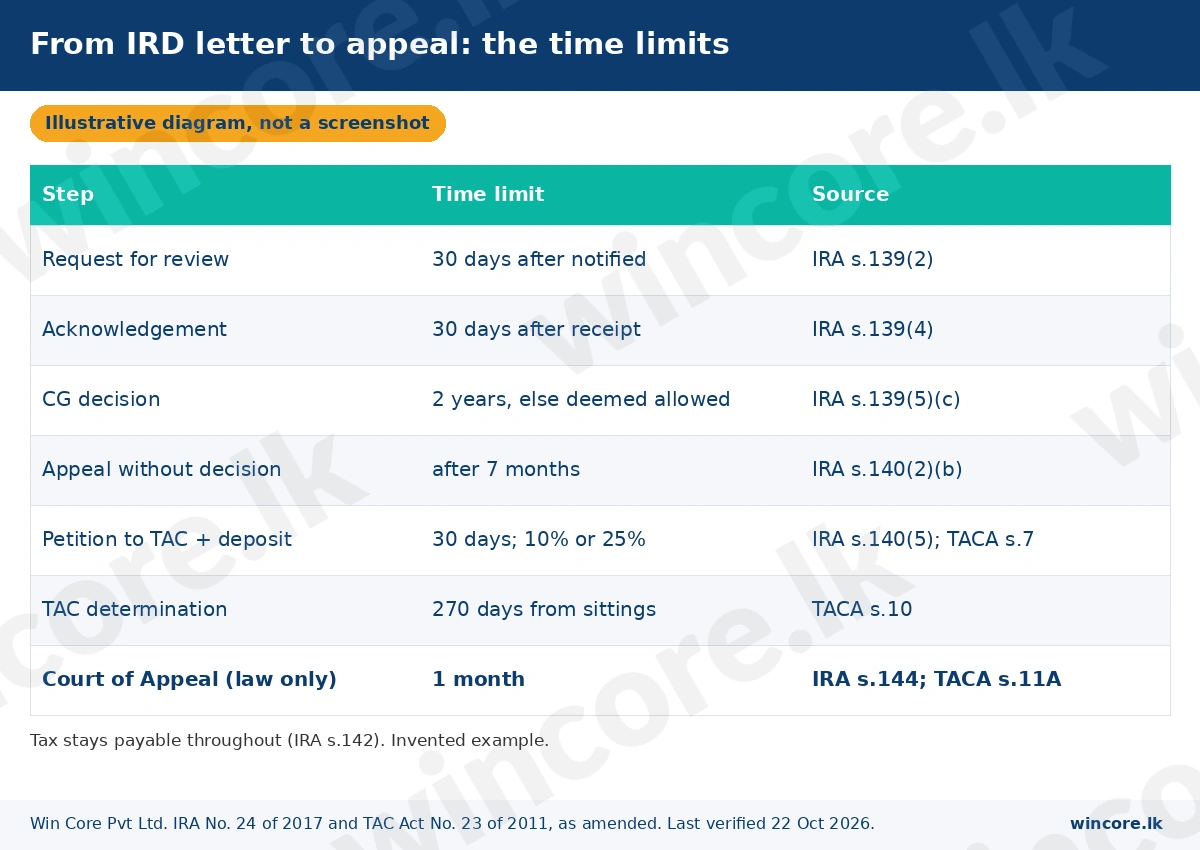
IRD assessment appeal Sri Lanka: the step table
| Step | Time limit | Source | Example date |
|---|---|---|---|
| Notice of assessment received | Clock starts | s.139(2) | 7 November 2026 |
| Request for administrative review | Not later than 30 days after notified | IRA s.139(2) | By 7 December 2026 |
| Acknowledgement of request | Within 30 days of receipt | IRA s.139(4) | By early January 2027 |
| Commissioner-General's decision | Within 2 years of receipt (the acknowledgement date, s.139(4)), or deemed allowed unless you have appealed | IRA s.139(5)(c) | |
| Earliest appeal without a decision | 7 months after the request | IRA s.140(2)(b) | 7 July 2027, if the request is made on 7 December 2026 |
| Petition to the Commission | 30 days from decision or from the 7-month point | IRA s.140(5); TACA s.7(2) | By 6 August 2027 on the 7-month route (our count) |
| Deposit or bank guarantee | At the time of appeal | TACA s.7(1) proviso | Rs 125,000 or Rs 312,500 |
| Hearing notice | 42 days | TACA s.9(1) | |
| Commission's determination | 270 days from start of sittings | TACA s.10 | |
| Court of Appeal | 1 month after notification, law only | IRA s.144; TACA s.11A | |
| Tax under the assessment | Remains payable throughout | IRA s.142 |
Records to keep
Keep the notice and proof of the date received, your request for review and the acknowledgement, every letter and email with the IRD, the return and workings for the year, the evidence for each ground, proof of any tax paid or extension granted, and the deposit or guarantee. Section 9(8) means evidence you do not put before the Commissioner-General may not be admitted later, so put it all in at the review stage. For finding the current text of a section, see our consolidated text guide. For filing on RAMIS, see our RAMIS filing guide.
What this means for you
- Object in writing, with detailed grounds, within 30 days of being notified.
- Keep paying, or get a written extension: objecting does not suspend the tax.
- Put all your evidence in at review; the Commission may refuse new documents.
- Budget for the 10% non-refundable payment, or the 25% refundable deposit or bank guarantee, before appealing.
Checklist: documents needed
- The notice of assessment and proof of the date received
- Written request for review with detailed grounds
- Return and computations for the year
- Invoices, contracts and payment evidence for each ground
- IRD acknowledgement and correspondence
- Proof of tax paid or extension under section 151
- Deposit receipt or bank guarantee for any appeal
FAQ
How long do I have to object to an IRD assessment?
Section 139(2) of the Inland Revenue Act requires the request for review in writing not later than thirty days after you were notified of the assessment, with detailed grounds. A late request is possible under section 139(8) only if absence from Sri Lanka, sickness or other reasonable cause prevented it and there was no unreasonable delay.
Do I have to pay the tax while my objection is open?
Yes, unless the Commissioner-General grants an extension of time under section 151. Section 142 says the tax under the assessment remains due and payable, and may be recovered, despite a request for review or an appeal. Ask for any extension in writing and keep the reply.
What deposit is needed to appeal to the Tax Appeals Commission?
Under section 7(1) of the Tax Appeals Commission Act, as substituted in 2013, the appellant pays either 10% of the sum assessed by the Commissioner-General, non-refundable, or 25% refundable, or gives a bank guarantee for that 25%, valid until the appeal is determined. It is paid at the time of making the appeal.
What if the Commissioner-General never decides?
For requests made on or after 8 May 2023, section 139(5)(c) requires a decision within two years of receipt; otherwise the request is deemed allowed, unless you have already appealed. Separately, section 140(2)(b) lets you appeal once seven months have passed without a decision, within thirty days of that point.
The short version
Thirty days to object, in writing, with grounds. Keep paying. Seven months or a decision, then thirty days to petition the Commission, paying 10% non-refundable or 25% refundable (or giving a bank guarantee for the 25%). Then one month to the Court of Appeal, on law only.
Talk to us. If you have received an IRD letter, see our tax return filing services, which list "IRD audit and inquiry support".
WinCore Pvt Ltd
This article is general information on the law as at 26 October 2026 and is not advice on your specific position.
Sources and references (6)
- Parliament of Sri Lanka. Inland Revenue Act, No. 24 of 2017 (certified 24 October 2017), ss.133(1), 139(1), (2), (4), (6) and (8), 141, 142, 143(1) and 144. https://www.ird.gov.lk/en/publications/Acts_Income%20Tax_2017/IR_Act_No_24_2017_E.pdf . Primary. Accessed 24 October 2026.
- Parliament of Sri Lanka. Inland Revenue (Amendment) Act, No. 10 of 2021 (certified 13 May 2021), ss.1 and 42 to 43 and Tables A and B. https://www.ird.gov.lk/en/publications/Acts_Income%20Tax_2017/IR_Act_No._10_2021_E.pdf . Primary. Accessed 24 October 2026.
- Parliament of Sri Lanka. Inland Revenue (Amendment) Act, No. 4 of 2023 (certified 8 May 2023), ss.1(2) and 13. https://www.ird.gov.lk/en/publications/Acts_Income%20Tax_2017/IR_Act_No._04_2023_E.pdf . Primary. Accessed 24 October 2026.
- Parliament of Sri Lanka. Inland Revenue (Amendment) Act, No. 11 of 2026 (certified 3 June 2026), s.31 (new s.185A). https://www.ird.gov.lk/en/publications/Acts_Income%20Tax_2017/IR_Act_No_11-2026_E.pdf . Primary. Accessed 24 October 2026.
- Parliament of Sri Lanka. Tax Appeals Commission Act, No. 23 of 2011, read with the IRD consolidation to 30 April 2013 for ss.7(2), 9, 10 and 11A. https://www.ird.gov.lk/en/publications/Acts_Tax%20Appeals%20Commission/TAC_Act_No_23%5BE%5D_2011_%28Consolidation_2013%29.pdf . Consolidation used to locate text; amending Act at [6]. Accessed 24 October 2026.
- Parliament of Sri Lanka. Tax Appeals Commission (Amendment) Act, No. 20 of 2013 (certified 24 April 2013), ss.4, 6, 7 and 8. https://www.ird.gov.lk/en/publications/Acts_Tax%20Appeals%20Commission/TAC_Amd_Act%20No.%2020_2013_E.pdf . Primary. Accessed 24 October 2026.
Related reading: Amend income tax return Sri Lanka: a guide.
Put these insights to work
WinCore specialists can review your current workflow, document gaps, and build a practical 90-day action plan.
Book a free consultationRecent articles


Continue reading
Explore more WinCore analysis to keep your finance, tax, and compliance roadmap moving.
RAMIS penalty guide for Sri Lanka with the legal rules for late filing, late payment, interest and incorrect returns, plus practical prevention controls.

Step-by-step guide to filing income tax returns in Sri Lanka: deadlines, RAMIS process, relief, bands, WHT credits, and common penalty traps.

Acts, Gazettes, IRD consolidations and circulars do not carry the same weight. How to tell which text is the law, and which dates to check first.