
Gratuity provision Sri Lanka: accounting for future payments
See how an eligible company measures gratuity earned by employees, records the annual movement and checks the tax treatment of a payment.

On this page
Last verified against the primary sources on 2 November 2026.
Gratuity provision Sri Lanka, in brief. Under the 2015 SLFRS for SMEs, a company applying Section 28 measures a defined benefit obligation for employee service already given, including benefits that have not yet vested. The Payment of Gratuity Act, No. 12 of 1983, generally requires a qualifying employer to pay an eligible workman with five completed years within thirty days of termination [1]. An accounting provision and an income tax deduction are different questions [2] [3].
This article uses a hypothetical cold storage operator with 33 employees to explain the legal starting point, measurement under the 2015 SME standard, entries, disclosure and tax treatment. It also identifies a change in the international SME standard for reporting periods beginning from 2027. The figures are illustrative, not a valuation of a real business.
The gratuity provision Sri Lanka employers measure starts with the Act
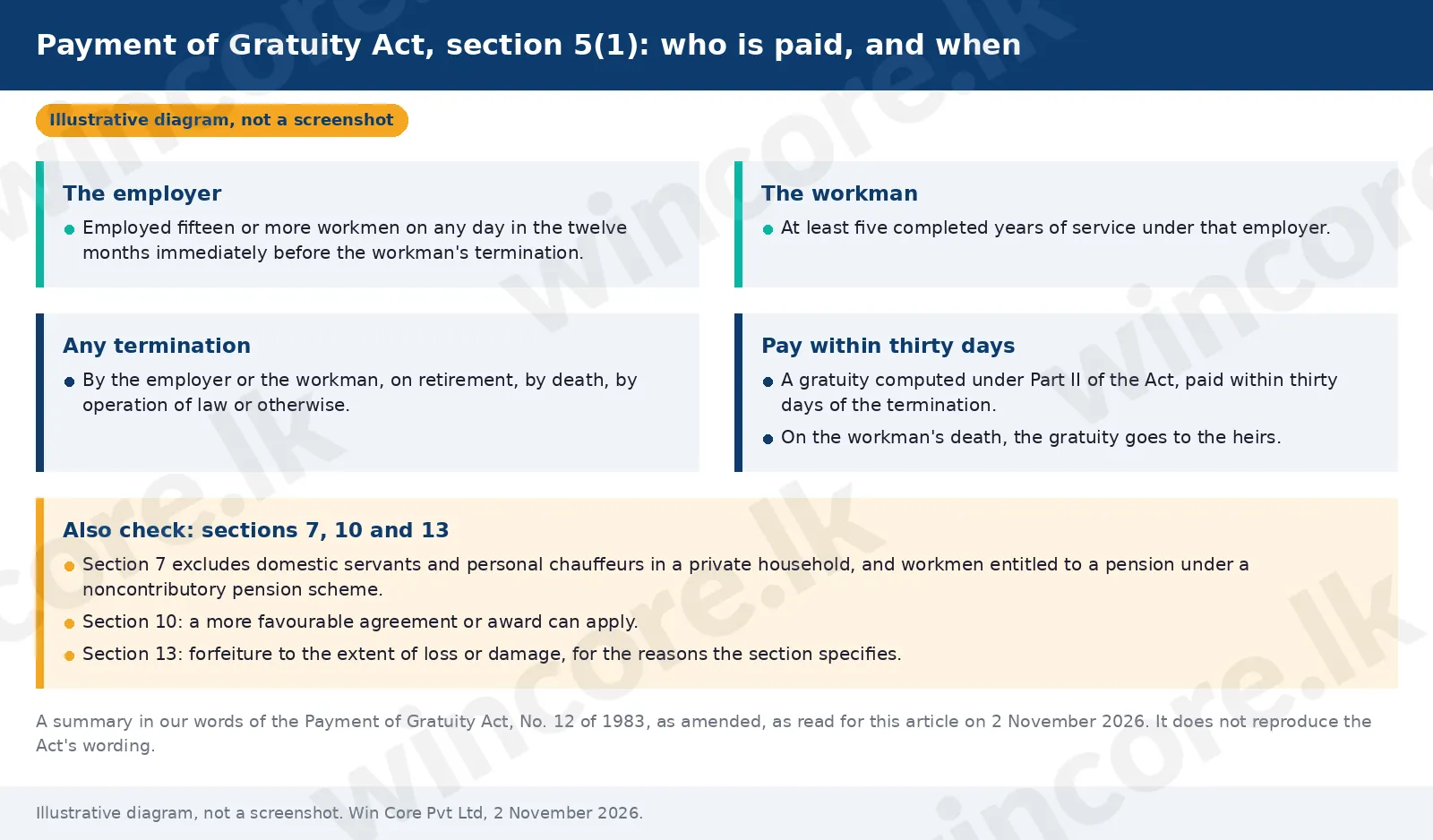
Section 5(1) of the Payment of Gratuity Act No. 12 of 1983 applies where an employer employed fifteen or more workmen on any day in the twelve months immediately before a workman's termination. Subject to the Act's exceptions, the employer must pay a workman with at least five completed years of service within thirty days of termination. If the workman dies, the payment goes to the heirs [1].
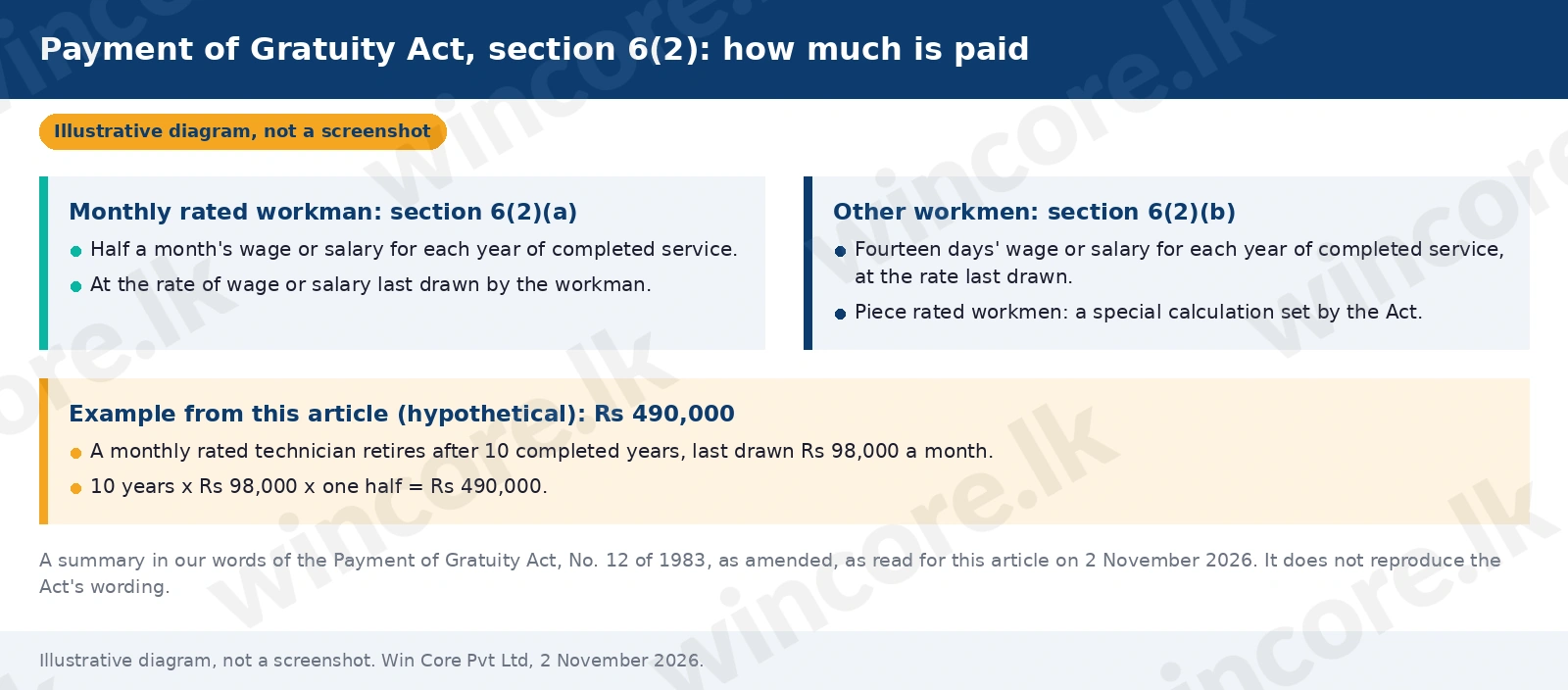
For a monthly rated workman, section 6(2)(a) sets half a month's last drawn wage or salary for each completed year of service. For other workmen, section 6(2)(b) sets fourteen days' last drawn wage or salary per completed year, with a special calculation for piece rated workmen [1].
Section 7 excludes domestic servants and personal chauffeurs in a private household and workmen entitled to a pension under a noncontributory pension scheme. A more favourable agreement or award can apply under section 10; section 13 provides for forfeiture to the extent of loss or damage for the specified reasons. Employment records and the terms of the plan matter when determining each person's benefit [1].
The operator has 33 qualifying workmen at the reporting date. Assume none falls within section 7 and the headcount remains at or above fifteen. The full clause reading, including the surcharge for late payment, is in our Payment of Gratuity Act guide.
A defined benefit obligation includes unvested service
The benefit depends on pay and service. For a company applying the 2015 SLFRS for SMEs, this is a defined benefit obligation: paragraph 28.14 requires a liability net of any plan assets. Paragraph 28.15 measures the obligation at present value less the fair value of plan assets, if any [2].
Paragraph 28.16 includes benefits earned for service to the reporting date even when they have not vested. Thus a qualifying employee with fewer than five years of service is included in the calculation, although the Act's five year condition for payment on termination has not yet been met. Estimates should reflect the plan terms and relevant assumptions, including turnover where appropriate [2].
Companies applying full SLFRS use LKAS 19 for defined benefit obligations. Paragraph 67 requires the projected unit credit method and paragraph 120 places remeasurements in other comprehensive income, subject to the stated asset cost exception. Paragraph 59 encourages a qualified actuary for material obligations but does not require one [4]. The SME relief below is a separate rule.
The 2015 SME standard permits simplifications on conditions
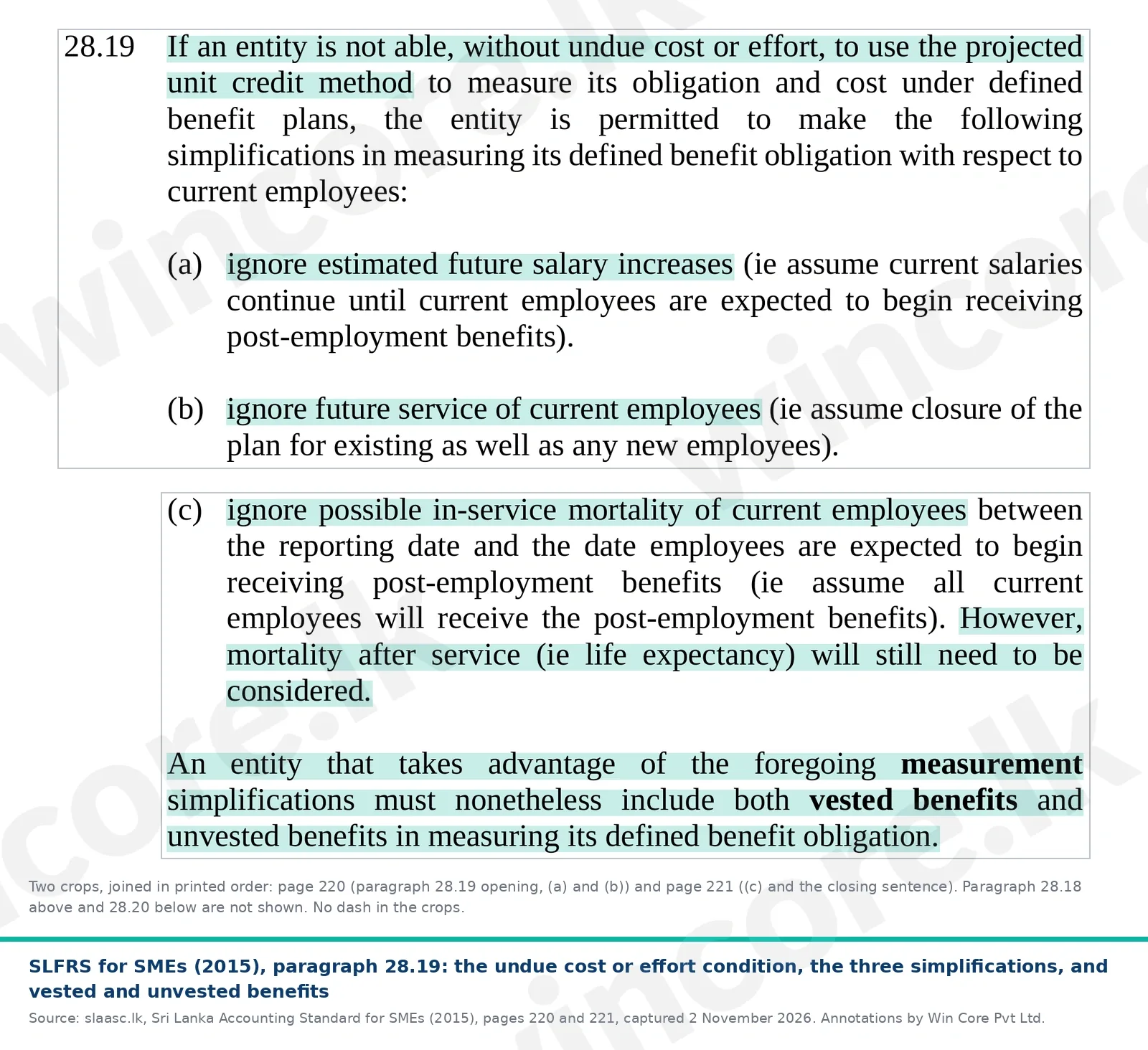
Under paragraph 28.18, an entity able to use the projected unit credit method without undue cost or effort must use it. If that method would involve undue cost or effort, paragraph 28.19 permits the entity to ignore estimated future salary increases, future service of current employees and possible mortality during service. Mortality after service remains relevant where applicable. The calculation must still include vested and unvested benefits [2].
The 2015 paragraph 28.17 requires the obligation to be measured at discounted present value. The discount rate is based on market yields on high quality corporate bonds at the reporting date, or government bond yields where there is no deep market in such corporate bonds; currency and term must match the expected payments. A salary times service schedule is a starting point, not automatically the final provision [2].
Paragraph 28.20 does not require an independent actuary or a comprehensive valuation every year. Between comprehensive valuations, the prior measurement can be adjusted for changes such as staff numbers and salaries if the principal actuarial assumptions have not changed significantly. Not hiring an actuary does not itself establish that the projected unit credit method involves undue cost or effort [2].
The 2015 amendments to the Sri Lankan SME standard apply to annual periods beginning on or after 1 January 2017, with earlier application permitted [2]. The international IFRS for SMEs third edition applies to annual periods beginning on or after 1 January 2027, with earlier application permitted. Its paragraph 28.19 changes the simplification: it assumes all employees terminate at the reporting date and does not discount the obligation, while still including vested and unvested benefits [5]. Check which locally adopted edition applies to the reporting period before using either method.
The yearly entries depend on the measured movement
Under paragraph 28.23, the cost for the period is the change in the defined benefit liability excluding benefit payments and employer contributions. The cost may be recognised in profit or loss or partly in other comprehensive income, or included in an asset's cost when another section requires it [2].
At the year end: for a net increase in a simple unfunded plan, debit the appropriate expense and credit the provision for the cost allocated to profit or loss. A net decrease can require the entries to be reversed. Record any actuarial gain or loss in the place required by the company's accounting policy. If another section requires a cost to be included in an asset, record that component accordingly.
When an eligible employee leaves: debit the provision for the gross obligation settled and credit bank for the amount paid. Credit APIT payable for any tax required to be withheld. The gross payment and any withholding should be supported by the employee's calculation and payroll records.
Paragraph 28.24 requires an entity to recognise actuarial gains and losses in the period and choose, consistently for all its defined benefit plans, either profit or loss or other comprehensive income. The absence of an independent actuary does not remove this choice [2].
The note explains the plan, assumptions and movement
Paragraph 28.41 requires a description of the plan and funding policy, the policy and amount for actuarial gains and losses, and disclosure of any paragraph 28.19 simplifications and why the projected unit credit method involves undue cost or effort. It also requires the most recent comprehensive valuation date and, where relevant, the adjustments since that valuation; a reconciliation of the obligation; total cost; and principal actuarial assumptions [2].
For a funded plan, further disclosures include the plan asset reconciliation, major asset classes and actual return. For the hypothetical operator, assume an unfunded statutory plan, no plan assets and no prior comprehensive actuarial valuation. The note would describe the method, explain the evidence for undue cost or effort, set out the assumptions and show the movement. An assumed small obligation alone does not establish the relief [2].
The tax computation tests provisions and actual obligations separately
The Inland Revenue Act applies an accrual basis to a business. Section 10(1)(b)(viii) disallows a transfer to a provision for expenditure not yet incurred but expected in a future year. Section 11 allows qualifying noncapital business expenses incurred in producing income. Under section 23(3), all events determining liability must have occurred, the amount must be reasonably determinable and economic performance must have occurred [3].
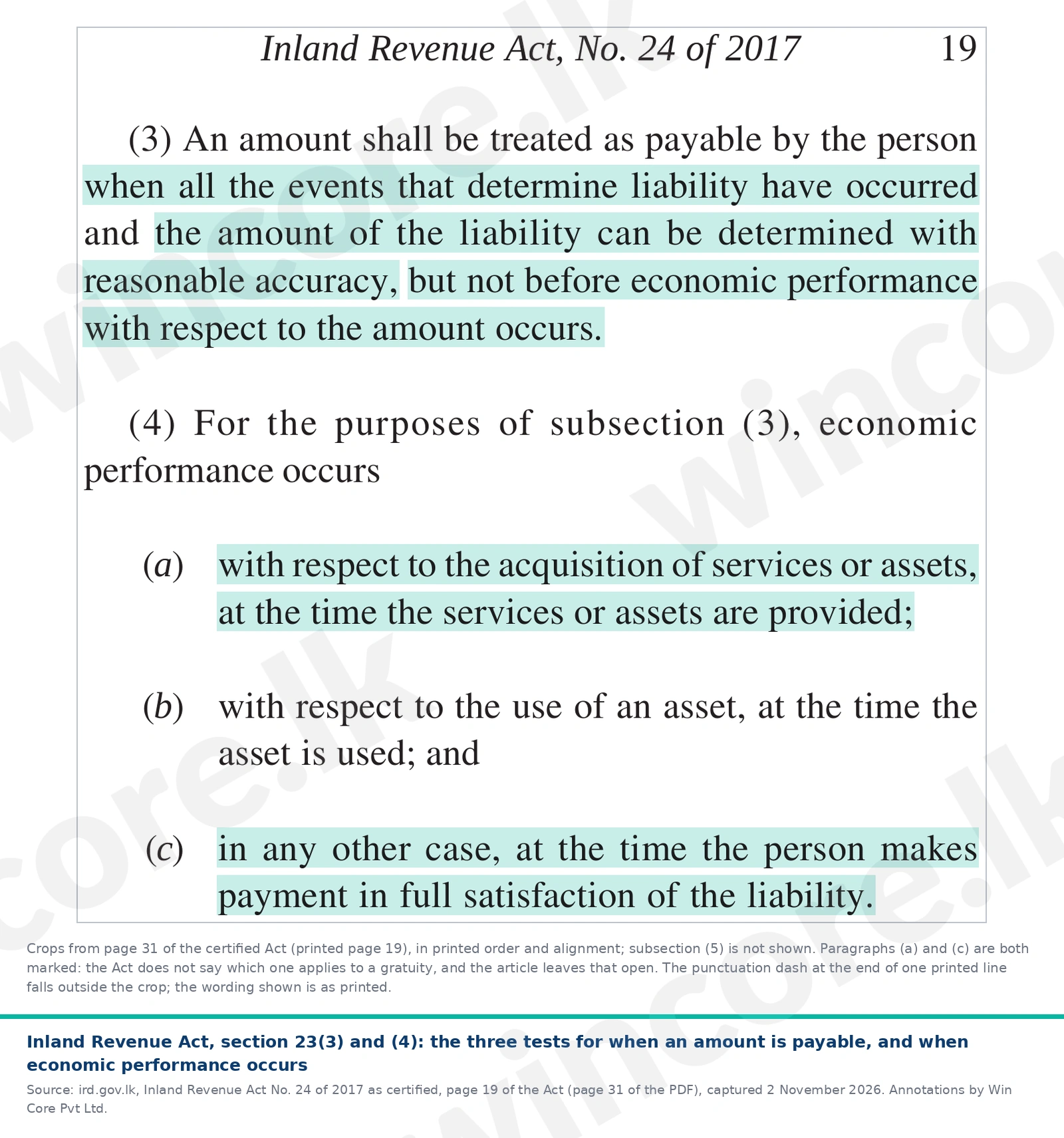
Section 23(4)(a) places economic performance for acquiring services or assets when they are provided; paragraph (c) places it at payment in full satisfaction in other cases. On our reading, the accounting estimate for future gratuities that has not yet been incurred is added back. The Act does not establish, from paragraph (c) alone, that every gratuity liability is deductible only upon payment. The applicable limb and the year of deduction for a fixed but unpaid gratuity remain an open point [3].
An actual gratuity payment may be deductible when the statutory conditions are met, to the extent it is incurred in producing business income and is not otherwise disallowed. Do not deduct it a second time if it was already deducted in an earlier year. Where tax must be withheld, section 10(2) defers the deduction until the withheld tax is paid to the Commissioner General. Section 10(2A) also restricts certain payments of Rs 500,000 or more made by nonqualifying methods, subject to its terms and exceptions; check for any later change [3] [6].
For deferred tax, a qualifying difference between the liability's carrying amount and tax base can be a deductible temporary difference. Paragraph 29.16 recognises a deferred tax asset only to the extent that sufficient taxable profit is probable, subject to its exceptions [2]. Apply the current IRD withholding rules to the employee's circumstances; our APIT on gratuity post gives background, and the gratuity payment guide covers payment.
Worked example: a measured obligation of Rs 6,068,458
Assume the operator qualifies for the paragraph 28.19 relief and has support for using it. These four hypothetical groups are monthly rated, covered by the Act and have no more favourable contractual benefit. All figures are in rupees.
| Group | Employees | Completed years | Monthly salary | Half month x years x headcount |
|---|---|---|---|---|
| 1, vested | 6 | 12 | 95,000 | 3,420,000 |
| 2, vested | 8 | 7 | 82,500 | 2,310,000 |
| 3, unvested | 11 | 3 | 72,000 | 1,188,000 |
| 4, unvested | 8 | 1 | 63,500 | 254,000 |
| Total | 33 | 7,172,000 |
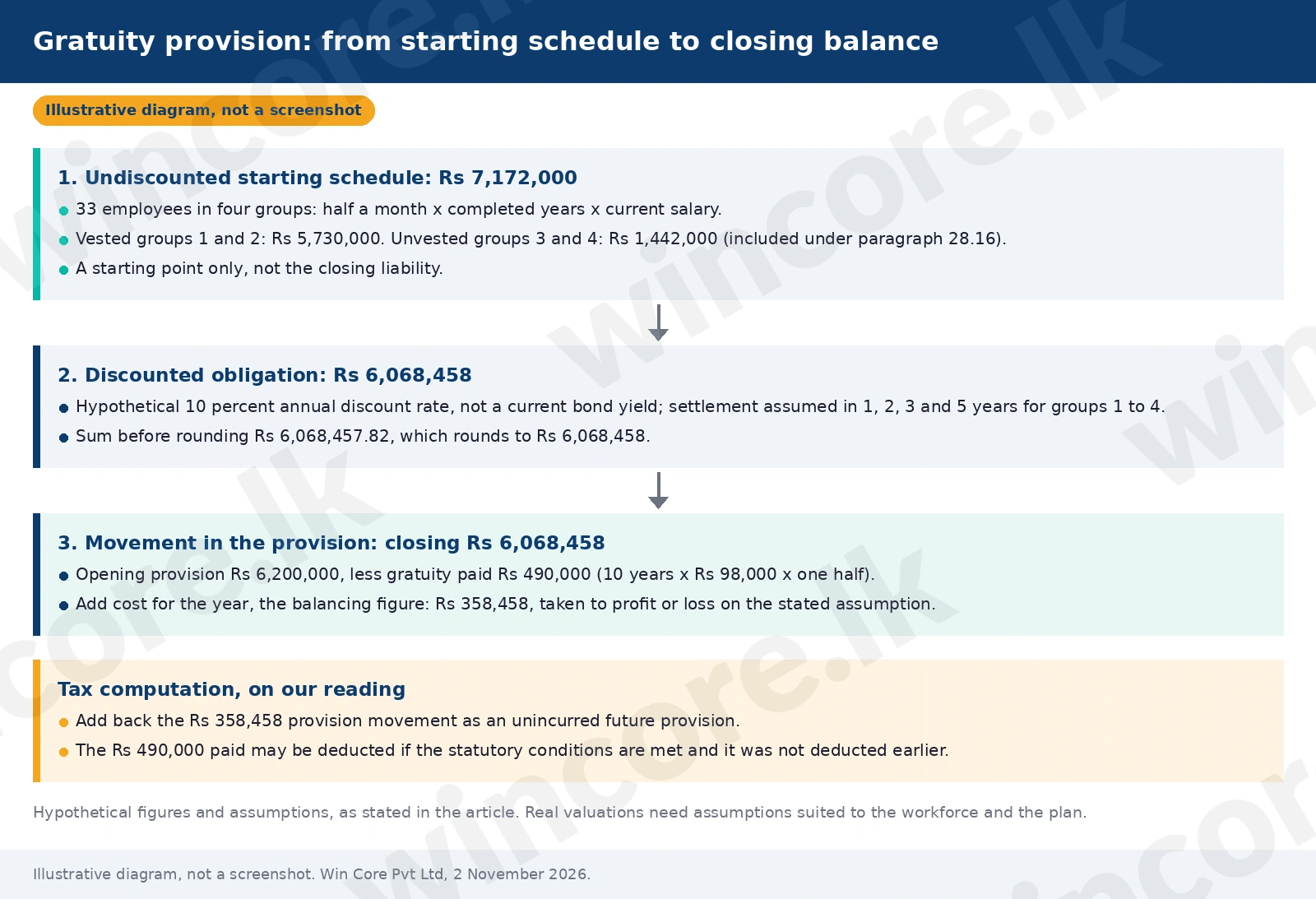
The Rs 7,172,000 is the undiscounted starting schedule, not the closing liability. For illustration, assume a 10 percent annual discount rate, expected settlement in one, two, three and five years for groups 1 to 4 respectively, no departures before those dates, and no post service mortality adjustment relevant to these lump sums. The rate is hypothetical, not a current bond yield. The unvested groups would have passed five years of service by their assumed settlement dates; assume departures are replaced so the headcount condition remains met.
Assume the permitted simplifications ignore future salary increases and future service when attributing the benefit to service already given. Divide each starting amount by 1.10 raised to the number of years to the assumed settlement. This simple illustration assumes the same timing and probability for each employee in a group. Real valuations need assumptions suited to the workforce and the plan.
| Group | Calculation | Present value, rounded |
|---|---|---|
| 1 | 3,420,000 / 1.10 | 3,109,091 |
| 2 | 2,310,000 / 1.10^2 | 1,909,091 |
| 3 | 1,188,000 / 1.10^3 | 892,562 |
| 4 | 254,000 / 1.10^5 | 157,714 |
| Total | Sum before rounding | 6,068,458 |
The four individually rounded values total Rs 6,068,458; the sum before rounding is Rs 6,068,457.82, which also rounds to Rs 6,068,458.
The opening provision was Rs 6,200,000. During the year a technician retired after ten years on Rs 98,000 a month. The gross gratuity was Rs 490,000, paid through the bank. The headcount of 33 is after that departure. Assume no tax had to be withheld on this payment and no earlier tax deduction was claimed.
| Movement | Rs |
|---|---|
| Opening provision | 6,200,000 |
| Less: gratuity paid | (490,000) |
| Add: cost for the year, balancing | 358,458 |
| Closing provision | 6,068,458 |
Assume the entire cost is recognised in profit or loss and no part must be included in an asset. The entries are a debit to staff costs and credit to the provision of Rs 358,458, and a debit to the provision and credit to bank of Rs 490,000. If withholding is required, the bank and APIT credits must instead add up to the gross payment.
For the tax computation, assume the Rs 358,458 is an unincurred future provision and is added back. On our reading, the Rs 490,000 paid can be deducted if it meets the income production and other conditions and was not deducted earlier. The two amounts differ because the accounting movement and the payment measure different things. Vested benefits in the undiscounted starting schedule total Rs 5,730,000; that figure alone is not the 2015 Section 28 measure.
What this means for you
First identify the accounting framework and edition that applies to your reporting period. Keep a staff schedule with service, salary and plan terms, including employees whose benefits have not vested. Measure the liability using supported assumptions and the permitted method, then reconcile the movement and prepare the disclosure. Separately assess the tax deduction and retain the payment and withholding evidence.
Checklist: documents needed
- Employee list with start dates, service and current salaries
- Last year's gratuity schedule and closing provision
- Leavers, gratuity calculations, bank payments and any APIT records
- Agreements or awards affecting gratuity
- Valuation, assumptions and evidence for any simplification
- Calculation of the year's movement and journal entries
- Draft accounting policy and disclosure note
- Tax computation and record of any earlier deduction
FAQ
Does every Sri Lankan company need a gratuity provision?
No. The answer depends on the applicable accounting framework and the company's legal or constructive obligations. The Act's fifteen workmen test is assessed over the twelve months before a termination, and section 7 excludes certain workmen. A contract or award can create an obligation even where the section 5 threshold is not met [1] [2].
Can a small company use half a month per year instead of an actuary?
Not automatically. Under the 2015 SME standard, the projected unit credit method is required if it can be used without undue cost or effort. Eligible simplifications still include unvested benefits and require discounting. An independent actuary is not mandatory, but that fact alone does not justify the simplifications [2].
Is a gratuity provision tax deductible in Sri Lanka?
An unincurred future provision is not deductible merely because it is booked. Section 10 restricts such provisions, while sections 11 and 23 set the deduction and accrual tests. On our reading, a qualifying payment may be deducted when the conditions are met, without repeating an earlier deduction; the timing of a fixed but unpaid liability remains an open point [3].
Do employees under five years count in the provision?
Yes, when measuring benefits under the 2015 SLFRS for SMEs, vested and unvested benefits are included. The calculation estimates the benefit earned for service already given and applies the relevant assumptions. The Act's separate five year test determines statutory payment eligibility on termination, subject to its other conditions and exceptions [1] [2].
The short version
- The Act sets a fifteen workmen test, five completed years and a thirty day payment period for eligible terminations [1].
- Under the 2015 SLFRS for SMEs, the defined benefit measure includes unvested service and is discounted [2].
- Paragraph 28.19 permits specified simplifications only where the projected unit credit method involves undue cost or effort [2].
- Record the measured cost and payments separately, and disclose the assumptions and policy [2].
- An unincurred future provision is not automatically deductible. Test the actual obligation and any payment under the Inland Revenue Act [3].
Free download: the Gratuity Calculation Worksheet (Sri Lanka) (PDF).
Talk to us. For Financial Statements and Management Reporting, see our accounting services or book a consultation at wincore.lk/contact.
WinCore Pvt Ltd
This article is general information as at 2 November 2026 and is not tax, legal or accounting advice on your specific position.
Sources and references (8)
- Parliament of Sri Lanka. Payment of Gratuity Act, No. 12 of 1983, sections 5 to 7, 10, 13 and 20. Certified Act as enacted; read with the amending Acts No. 41 of 1990 and No. 62 of 1992. https://www.parliament.lk/uploads/acts/gbills/english/3120.pdf . Primary. Accessed 2 November 2026.
- Institute of Chartered Accountants of Sri Lanka. Sri Lanka Accounting Standard for SMEs, 2015, paragraphs 28.10, 28.14 to 28.20, 28.23 to 28.25, 28.41, 29.16 to 29.17 and Appendix A. https://www.slaasc.lk/files/_SLFRS%20FOR%20SMEs%20-%202015.pdf . Primary. Accessed 2 November 2026.
- Inland Revenue Department. Inland Revenue Act, No. 24 of 2017, sections 10, 11, 21 and 23, as amended; certified Act https://www.ird.gov.lk/en/publications/Acts_Income%20Tax_2017/IR_Act_No_24_2017_E.pdf and consolidation to 2025 https://www.ird.gov.lk/en/publications/Acts_Income%20Tax_2017/IRA_Cons_Act_-_2025_Changes.pdf . Primary. Accessed 2 November 2026.
- Institute of Chartered Accountants of Sri Lanka. LKAS 19 Employee Benefits, 2025 bound volume, paragraphs 59, 67 and 120. https://www.slaasc.lk/files/LKAS%2019%20-%20Employee%20Benefits%20%20%20%20%20%20%20%20%20%20%20%20%20%20%20%20%20%20%20%20%20%20%20%20%20%20%20%20%20%20%20%20%20%20%20%20%20%20%20%20%20%20%20%20%20%20%20%20%20%20%20%20%20%20%20%20%20%20%20%20%20%20%20%20%20%20%20%20%20%20%20%20%20%20%20%20%20%20%20%20%20%20%20%20%20%20%20%20%20%20%20%20%20%20%20%20%20%20%20%20%20%20%20%20%20%20%20%20%20%20%20%20%20%20%20%20%20%20%20%20%20%20%20%20%20%20%20%20%20%20%20%20%20%20%20%20%20%20%20%20%20%20%20%20%20%20_1754036124_LKAS%2019-Employee%20Benefits.pdf . Primary. Accessed 2 November 2026.
- IFRS Foundation. IFRS for SMEs Accounting Standard, third edition, paragraphs 28.19 and 28.41 and Appendix A. https://www.ifrs.org/content/dam/ifrs/publications/ifrs-for-smes/english/2025/ifrs-for-smes.pdf?bypass=on . Primary. Accessed 2 November 2026.
- Inland Revenue Department. Inland Revenue Amendment Act, No. 11 of 2026, sections 1 and 3. https://www.ird.gov.lk/en/publications/Acts_Income%20Tax_2017/IR_Act_No_11-2026_E.pdf . Primary. Accessed 2 November 2026.
Related reading: Accounting standards Sri Lanka: who uses what?.
Put these insights to work
WinCore specialists can review your current workflow, document gaps, and build a practical 90-day action plan.
Book a free consultationRecent articles




Continue reading
Explore more WinCore analysis to keep your finance, tax, and compliance roadmap moving.

The sections that decide a gratuity claim: who is caught, who is excluded, how much, the day-30 due date and the surcharge Act No. 62 of 1992 added.

Gratuity under the Payment of Gratuity Act: employers of 15 or more, five years' service, the half-month and 14-day formulas, the 30-day deadline, surcharge and tax.

Gratuity and termination pay skip the monthly APIT tables. What Table 03 retains, when 36 percent applies, the 90 day direction and the Act's own rates.