
Change director details Form 20: updating a director's particulars
A director's new address, name or occupation is a change in particulars under section 223. How the twenty working days run and the eROC Form 20 steps.

On this page
Last verified against the primary sources on 3 November 2026.
Change director details Form 20, in brief. When a director or secretary changes a particular in the company register, section 223 of the Companies Act No. 7 of 2007 requires the company to ensure notice reaches the Registrar for registration within twenty working days of the company first becoming aware. The Act has operated since 3 May 2007. Form 20 is the prescribed notice; the eROC guide describes selecting the person, entering changes, signing, uploading and paying [1][2][5][6].
Form 20 covers appointments and resignations as well as changes to a director's or secretary's particulars. This article follows a hypothetical private company, Company A, whose director moves house. It sets out twelve steps: four from the Act, then eight eROC steps shown as labelled diagrams redrawn from the DRC Process B user guide, because the screens sit behind a company record, followed by the live Form 20 tile captured on 31 October 2026. For where Form 20 sits among a company's filings, see the map of company secretarial requirements in Sri Lanka.
Change director details Form 20 covers the particulars listed in section 223(1)
The company must ensure that notice of a change in the particulars contained in its register of directors and secretaries is delivered to the Registrar for registration. Form 20 provides for a change in director or secretary particulars [1][5]. Section 223(1)(a) lists, for an individual, "the present name and surname, any former name or surname, usual residential address and business occupation"; for a corporate secretary, section 223(1)(b) lists its "corporate name and registered or principal office" [1].
- Check which particular changed against the list in section 223(1). A new home address, a change of surname or a new business occupation each counts.
- Treat it as a change in particulars. Section 223(2)(b) requires notice in the prescribed form of "a change in the particulars contained in the register in respect of a director or secretary of the company" [1]. This is separate from section 223(2)(a), a change in the directors or secretary themselves.
- Note the twenty working days and the change date. Section 223(3) requires the notice to specify the date of the change and be delivered to the Registrar within twenty working days of the applicable starting point [1].
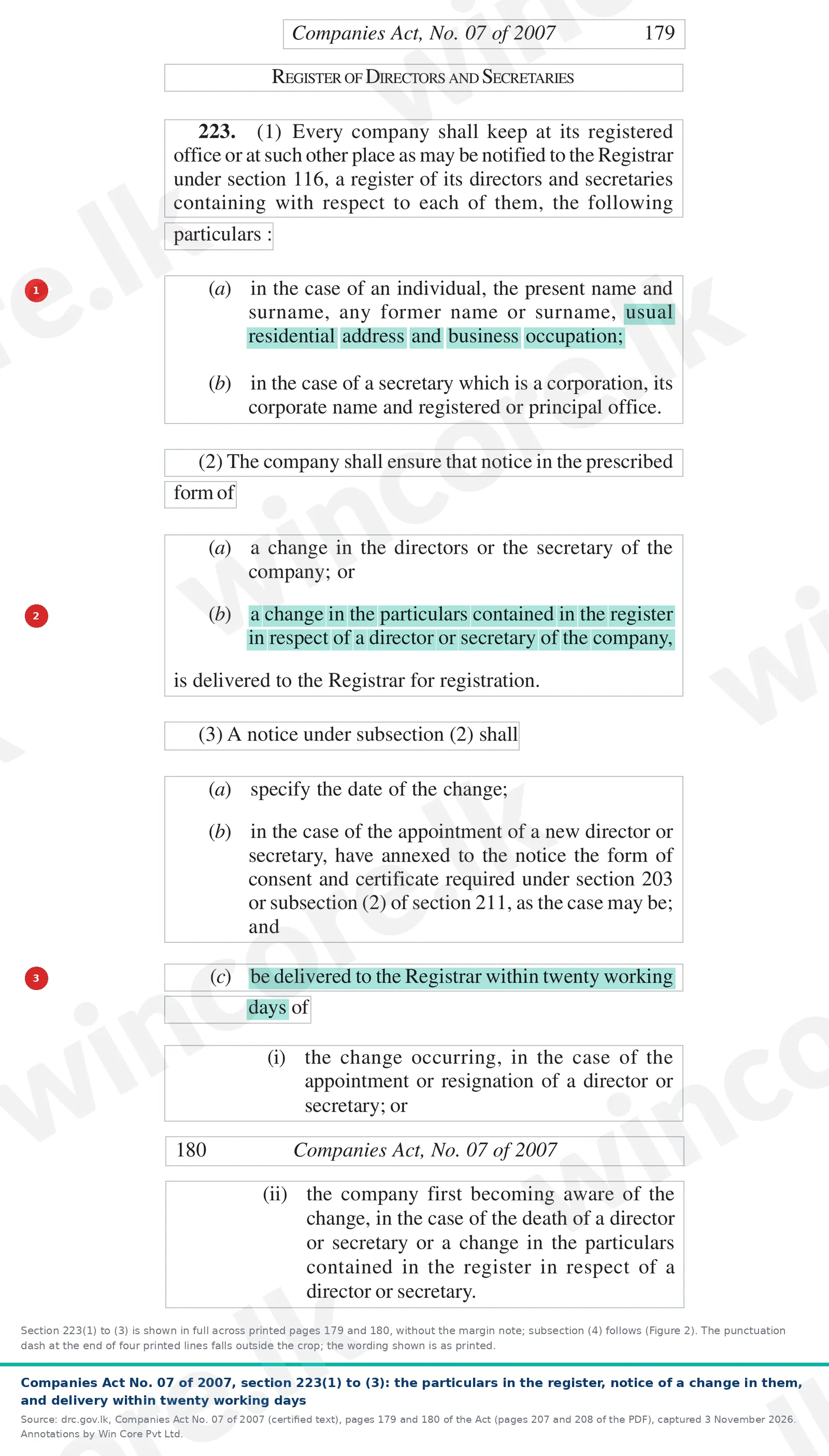
The twenty working days run from when the company first becomes aware of the change
For a change in particulars, section 223(3)(c)(ii) starts the twenty working day period when the company first becomes aware of the change. For appointments and resignations, section 223(3)(c)(i) starts it when the change occurs. A working day excludes Saturdays, Sundays and public holidays [1].
The Form 20 in Gazette 2354/12, published on 17 October 2023, states the period generally as twenty working days from the change occurring. Section 223(3)(c)(ii) specifies the first awareness starting point for changes in registered particulars. The two dates can be the same. As a precaution, report the change promptly and aim to deliver the notice within twenty working days of the change itself where possible [1][5].
- Record the day the company first became aware. Keep the director's dated letter or email as evidence of when the company learned of the change. This is practice, not a legal requirement to use a letter or email.
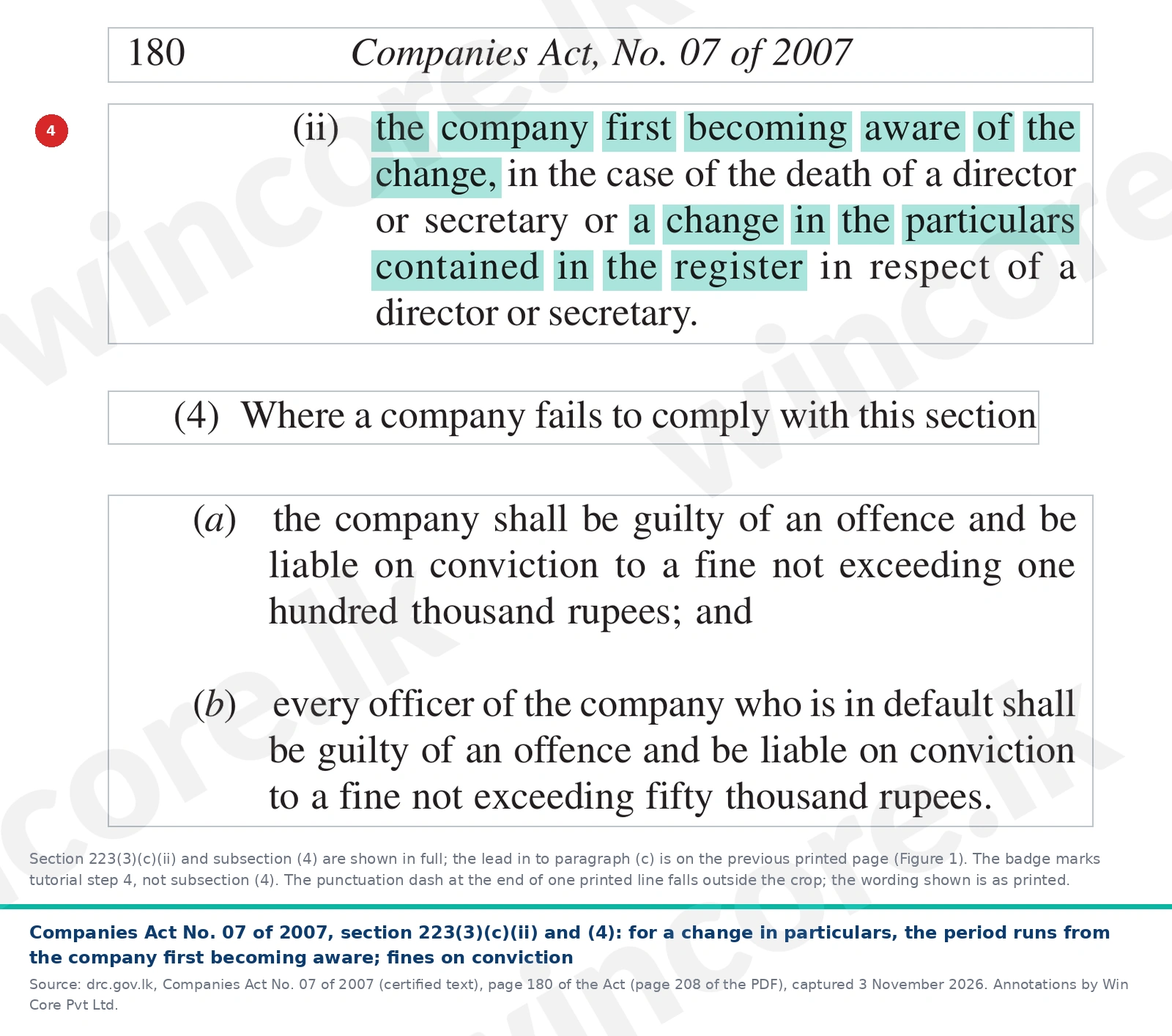
Section 223(4) makes a failure to comply an offence. On conviction, the company is liable to a fine not exceeding Rs 100,000 and every officer in default to a fine not exceeding Rs 50,000. An officer in default is one who knowingly and wilfully authorises or permits the default [1].
For a failure to deliver a required notice, section 514 permits the Registrar, at their discretion, to accept a composition sum instead of instituting or continuing court proceedings. Acceptance stops proceedings for that offence; the Act also provides for recovery if a composition sum remains unpaid [1]. Section 223 was not amended by the Companies (Amendment) Act No. 12 of 2025, in operation from 30 March 2026 [4][7].
Steps 5 to 8 on eROC select the person and open the details option
For an existing director, the eROC guide describes selecting the existing record and using its details option. The guide says Form 20 changes can be performed by a director, secretary or alternate director; it also describes editing an existing secretary. Figure 3 illustrates the process, not the live screen [2].
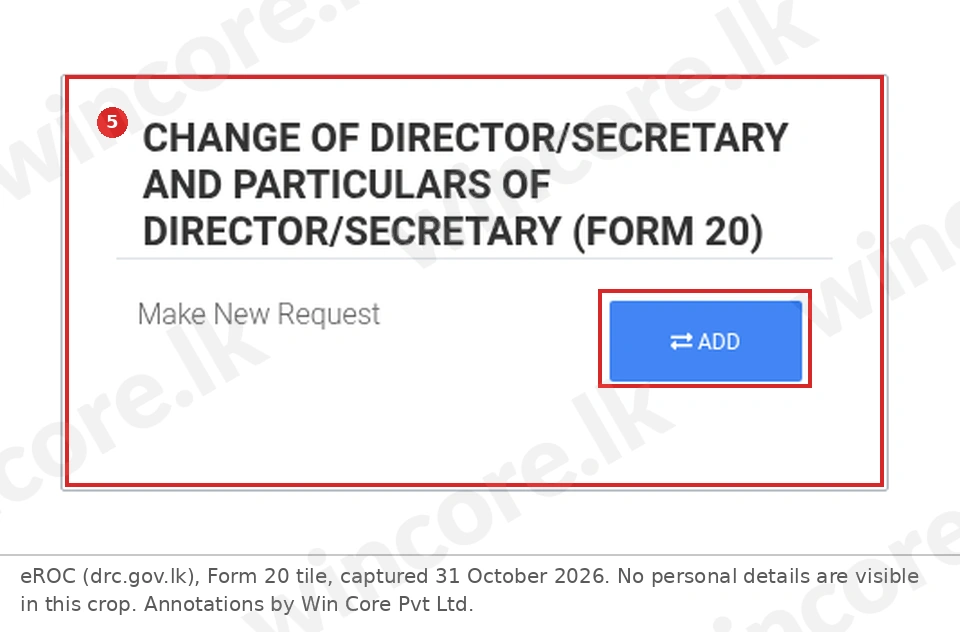
- Find and select Form 20 after logging in. Look for the Form 20 tile; the menu may call this area Other Changes [2].
- Select the relevant director or secretary from the existing list [2].
- Open the edit or details option for the person. The guide specifically describes the details option for a director and an edit symbol for a secretary [2].
- Enter the change in the available fields, including the effective date where requested, and continue with Next. Check the generated Form 20 before it is signed [1][2][5].
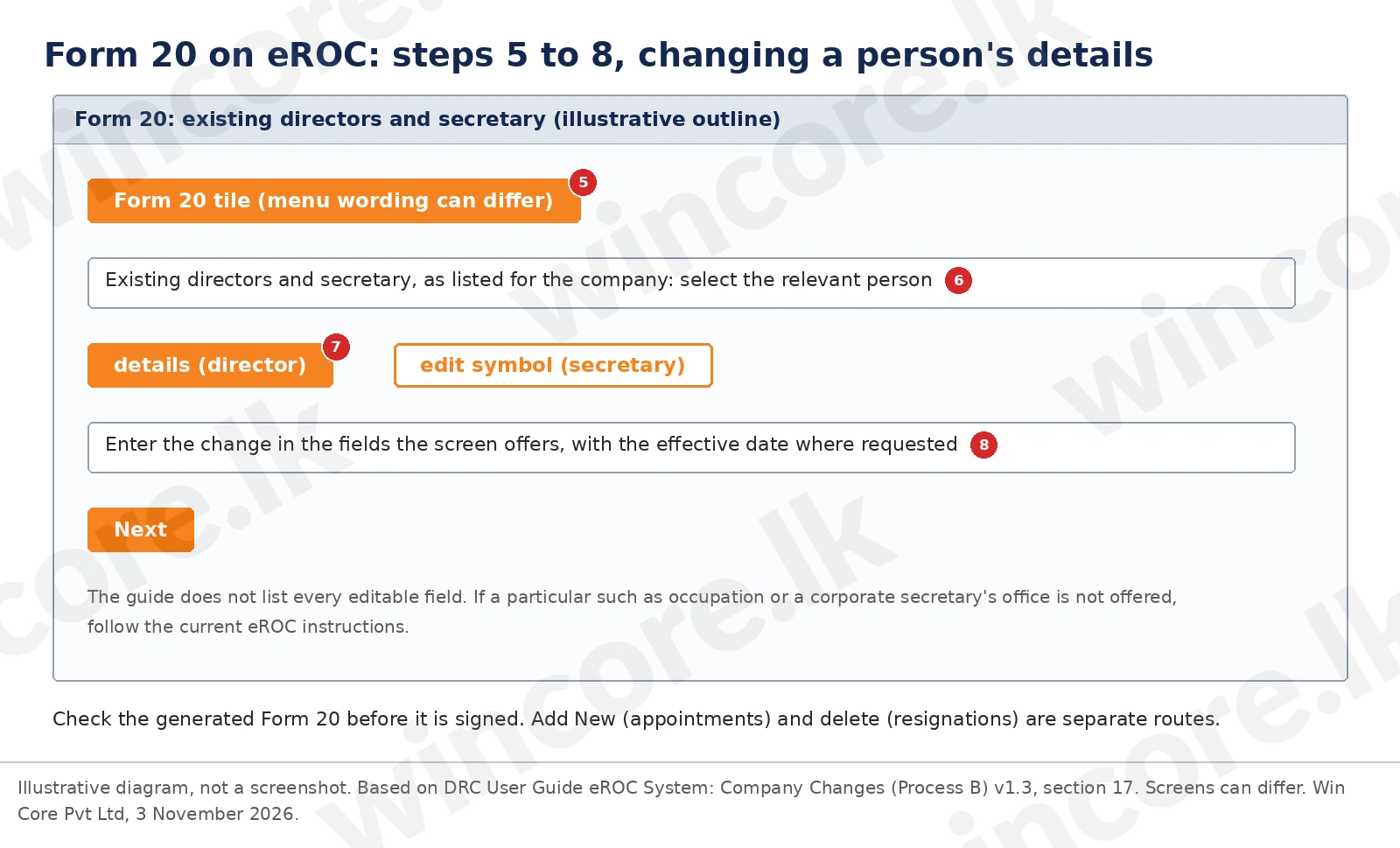
Figure 4 is the live Form 20 tile as captured on 31 October 2026. The diagram shows the later steps without displaying a company record.
The guide also describes Add New for appointments and a delete option with a reason and date for resignations [2]. Those routes are covered in our guide to appointing a director with Form 18 and Form 20 and our guide to changing the company secretary. The guide text does not establish which fields the current details screen allows a user to edit. The 2023 prescribed Form 20 includes columns for a change of name, NIC, residential address and email, with the effective date. Its displayed change table does not identify a business occupation field. If a particular such as occupation or a corporate secretary's office is not available, follow the current eROC instructions and check that the generated notice records the change required by section 223 [1][2][5].
Steps 9 to 12 download, sign, upload and pay
After the change, Form 20 closes with the same sequence as other change forms. Figure 5 shows the last four steps.
- Download the forms. After entering the changes, select Next to reach the forms [2].
- Sign, scan and upload. The guide directs the applicant to obtain the relevant director's or secretary's signature, then scan and upload the downloaded forms [2]. The prescribed Form 20 has a presented by section for a director or secretary [5].
- Agree to the terms and conditions. The guide says Next is enabled once the mandatory data in the upload section is filled [2].
- Pay and check the submission. Follow the payment steps. Check that eROC shows the notice as submitted and keep any submission acknowledgement as well as the payment receipt. A payment receipt alone does not prove that the notice was delivered [1][2].
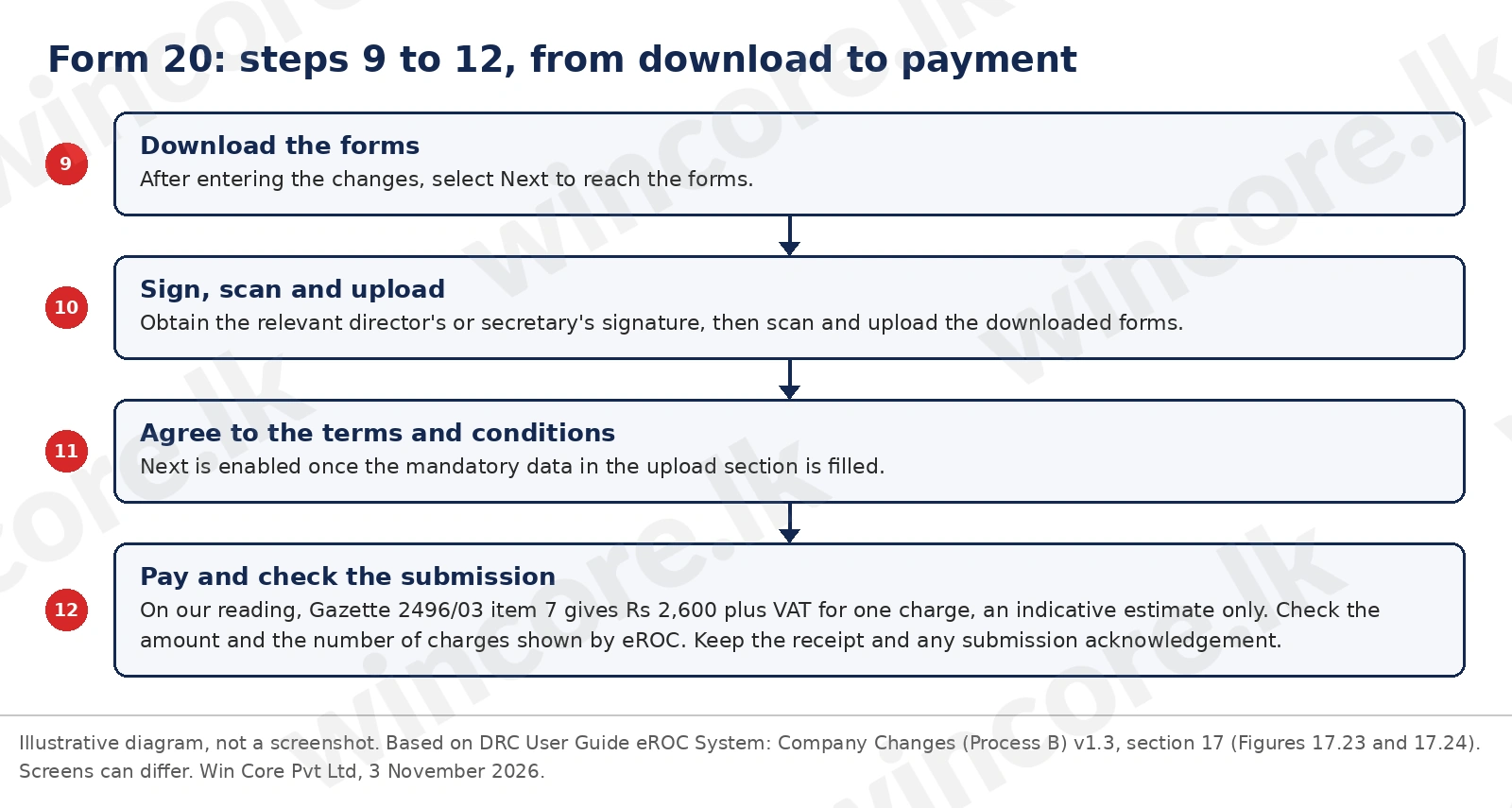
On our reading, Form 20 falls within the general document category in item 7 of Gazette 2496/03, published on 6 July 2026, at Rs 2,600 excluding VAT. At the 18 percent standard VAT rate in effect from 1 January 2024, the arithmetic is Rs 468 VAT and Rs 3,068 in total for one such charge [3][8]. This is an estimate, not a confirmed portal charge. Check for any later fee Order or VAT change before relying on it.
The 2023 schedule in Gazette 2354/12 gave Rs 2,300 excluding government taxes for registration of a form under section 223(2). The 2026 Order has no separate item for that form, so on our reading item 7 now applies and the 2023 figure is out of date. Check the amount and the number of charges eROC displays before paying, as the portal may charge for each person changed [3][5].
Keep the signed Form 20, the director's dated notice, the payment receipt and any submission acknowledgement together with the company's register. This is a record keeping practice, not a requirement to keep those particular documents together.
Worked example: Company A's director moves house
A director of hypothetical Company A moves and writes to the board on Day 0 with a new residential address. In this example, the change and the company's first awareness are on the same day. The later numbered days are working days after Day 0, excluding Saturdays, Sundays and public holidays.
| Step | Day | What Company A does |
|---|---|---|
| Company first aware | Day 0 | Keeps the director's dated letter |
| Update own register | Working day 2 | Changes the register at the registered office or another notified location |
| Deliver Form 20 | Working day 5 | Completes the notice and checks submission through eROC |
| Period | Twenty working days | Runs from first awareness under section 223(3)(c)(ii) |
| Indicative fee | Working day 5 | On our reading, Rs 2,600 plus Rs 468 VAT is Rs 3,068 for one charge; check the amount displayed |
The company can compare its own register under section 223(1) with the notice submitted, and retain the submission evidence. Our guide to statutory registers covers where the register of directors sits among the company's records.
What this means for you
Ask directors and the secretary to tell the company in writing when their name, home address or occupation changes, and date that notice. Update the company's register, then use the Form 20 route to arrange delivery of the notice within twenty working days of first awareness. The eROC guide describes a director, secretary or alternate director performing a Form 20 change. Check the fee and submission status in eROC [2]. Our company secretarial support services include Statutory Compliance and Corporate Document Maintenance.
The dated notice and retained payment and submission records below are practical records, not a statutory list of documents that must be filed.
Checklist: documents needed
- The director's or secretary's dated notice of the change
- The new particular: name, residential address or business occupation
- The updated register of directors and secretaries
- An eROC login for a director, the secretary or an alternate director
- The signed and scanned Form 20
- The fee displayed in eROC, checked before payment
- The receipt and any submission acknowledgement, for the company's records
FAQ
Does a director's change of address need Form 20 in Sri Lanka?
Yes. The usual residential address is one of the particulars in the register under section 223(1)(a) of the Companies Act. Section 223(2)(b) requires notice in the prescribed form of a change in those particulars, delivered within twenty working days. The eROC guide describes the details option in Form 20 for an existing director [1][2].
When does the twenty working day period start for a change in particulars?
From the company first becoming aware of the change. Section 223(3)(c)(ii) applies that start point to a change in particulars and to the death of a director or secretary. For an appointment or resignation, section 223(3)(c)(i) runs the period from the change occurring instead [1].
Who can file Form 20 on eROC?
The DRC Process B guide says a director, secretary or alternate director can perform Form 20 changes. The filer logs in, selects Form 20 and selects the existing person. The guide describes obtaining the relevant director's or secretary's signature on the downloaded forms, then scanning and uploading them [2].
What is the penalty for not notifying a change in director particulars?
Section 223(4) makes it an offence. On conviction, the company is liable to a fine not exceeding Rs 100,000, and an officer in default to a fine not exceeding Rs 50,000. For a notice default, section 514 also permits the Registrar, at their discretion, to accept a composition sum instead of court proceedings [1].
Does a corporate secretary's change of office need Form 20?
Yes. For a secretary that is a corporation, section 223(1)(b) lists its corporate name and registered or principal office in the register. A change in those particulars requires notice under section 223(2)(b), within twenty working days of the company first becoming aware. Check how the current portal records the change [1][2].
The short version
Change director details Form 20 applies when a director's or secretary's registered particulars change. Section 223(2)(b) requires the company to ensure notice, specifying the change date, is delivered within twenty working days of first awareness. Form 20 also states a general period from the change occurring, so act promptly. On eROC, select the existing person, enter the available change, download, sign, upload and pay; check the fee and submission status. On our reading, item 7 gives an indicative Rs 3,068 including VAT for one charge; check the amount eROC displays. A failure to comply is an offence under section 223(4), and section 514 provides for discretionary composition of a notice default.
Talk to us. For Statutory Compliance and Corporate Document Maintenance, see our company secretarial page or book a consultation at wincore.lk/contact.
WinCore Pvt Ltd
This article is general information as at 3 November 2026 and is not tax, legal or accounting advice on your specific position.
Sources and references (6)
- Department of the Registrar of Companies. Companies Act, No. 07 of 2007, sections 116, 223, 477, 514, 527 and 529. https://www.parliament.lk/uploads/acts/gbills/english/3776.pdf . Primary. Read 3 November 2026.
- Department of the Registrar of Companies. User Guide eROC System: Company Changes (Process B), version 1.3, section 17. https://erocapiv2.drc.gov.lk/pdf/Process%20b_frontend_V1.3.pdf . Primary. Supplied text extract read 3 November 2026.
- Minister of Trade, Commerce, Food Security and Co-operative Development. Companies (Fees) Orders, Gazette Extraordinary No. 2496/03 of 6 July 2026, Schedule item 7. https://drc.gov.lk/en/wp-content/uploads/2026/07/2496-03_E.pdf . Primary. Supplied Gazette read 3 November 2026.
- Parliament of Sri Lanka. Companies (Amendment) Act, No. 12 of 2025, including section 8 and the correction Schedule, in operation from 30 March 2026. https://www.parliament.lk/uploads/acts/gbills/english/6389.pdf . Primary. Read 3 November 2026.
- Minister of Industries. Regulations amending the Companies (Fees) Regulations 2007 (new Schedule, item 11) and the Companies (Returns, Notices and Documents) Regulations 2007 (replacement Form 20), made 16 October 2023, Gazette Extraordinary No. 2354/12 of 17 October 2023. The same Gazette also carries amendments to the Companies (Secretaries) Regulations, No. 1 of 2023. Named without a link. Primary. Read 3 November 2026.
- Department of the Registrar of Companies. Performance Report and Annual Accounts 2018, introduction, operation date of the Companies Act. https://www.parliament.lk/uploads/documents/paperspresented/performance-report-department-of-the-registrar-of-companies-2018.pdf . Official report, secondary source for the commencement date. Read 3 November 2026.
- Minister of Trade, Commerce, Food Security and Cooperative Development. Order under section 1(2) of the Companies (Amendment) Act, No. 12 of 2025, Gazette Extraordinary No. 2480/47 of 21 March 2026. Named without a link. Primary. Supplied Gazette read 3 November 2026.
- Minister of Finance, Economic Stabilization and National Policies. Order under section 2A of the Value Added Tax Act, Gazette Extraordinary No. 2363/22 of 19 December 2023, effective 1 January 2024. https://www.ird.gov.lk/en/publications/Gazette_Documents/2023_2363-22_E.pdf . Primary. Read 3 November 2026.
Put these insights to work
WinCore specialists can review your current workflow, document gaps, and build a practical 90-day action plan.
Book a free consultationRecent articles



Continue reading
Explore more WinCore analysis to keep your finance, tax, and compliance roadmap moving.

Appoint a director in Sri Lanka: the Form 18 consent, who may appoint, the twenty-working-day Form 20 deadline, the registers and the IRD record.

Changing a company secretary step by step: the board resolution, Form 19 consent, Form 20 within 20 working days, the fee and the handover.

Which registers a Sri Lankan company must keep, where they may be kept, who can inspect them, how long to keep them and the ten-working-day notices.