
Annual leave Sri Lanka: 14 days, casual leave and leave at exit
Annual, casual and sick leave for shop and office staff under the Shop and Office Employees Act: the 14-day rule, the first-year scale and leave at exit.
On this page
Last verified against the primary sources on 26 October 2026.
Under the annual leave Sri Lanka rules for shops and offices (section 6 of the Shop and Office Employees Act, text checked on 26 October 2026), an employee gets 14 days a year with full remuneration, at least 7 of them consecutive, from the second year of employment, and 14, 10, 7 or 4 days in the first year depending on the quarter in which employment starts. The rules come from section 6 of the Shop and Office Employees (Regulation of Employment and Remuneration) Act, which also gives up to 7 days of casual leave for private business or ill health. Leave earned in one year is taken in the next, and at exit the employee takes the days due or is paid for them. This guide quotes each rule, works through an office employee who joined in July, and marks where the contract decides. For the wider picture, see our Shop and Office Employees Act guide.
Check first whether the Act or a Wages Board decision covers the worker
The Act applies to persons "employed in or about the business of any shop or office". Section 68 defines "shop" as "any premises in which any retail or wholesale business is carried on". "Office" covers listed businesses such as a "joint stock or other company", and includes "the office or clerical department of any shop, factory, estate, mine, hotel, club or other place of entertainment, or of any other industrial, business or commercial undertaking" [1].
So the accounts clerk at a hardware wholesaler is covered, and so is the office administrator at a rubber products manufacturer. The machine operator on the factory floor at the same manufacturer may not be.
Workers in a trade that has a Wages Board are also covered by the Wages Boards Ordinance and that board's decisions, which set their own leave and pay figures. Section 37 of the SOE Act keeps only the Act's Part III remuneration determinations away from those trades: no determination under Part III shall apply "to any persons employed in any trade or work to which the provisions of Part II of the Wages Boards Ordinance has been made applicable by Order made under section 6 of that Ordinance" [1]. Section 37 says nothing about leave, and section 70(1) makes the Act "in addition to and not in substitution for" other written law. On our reading, a person employed in or about a shop or office keeps the section 6 leave even where a Wages Board decision also covers the trade, and any more favourable right under that decision is kept by section 70(2).
To tell which law applies to a worker, ask three questions:
- Is the worker's job in an office or clerical department, or in a shop as defined?
- Has an Order under section 6 of the Wages Boards Ordinance applied Part II to the trade the worker is employed in?
- If so, does that board's decision cover this worker's grade?
If question 2 is yes, also check the Wages Board decision. This guide does not cover Wages Board leave figures.
Annual leave Sri Lanka: the leave table under the Shop and Office Employees Act
| Leave type | Days | When earned | Section |
|---|---|---|---|
| Annual holiday, first year | 14, 10, 7 or 4 days, by the quarter in which employment starts | In the first year of employment; taken in the next year | s.6(1)(a), 6(2) |
| Annual holiday, later years | 14 days, at least 7 consecutive | In each later year of employment; taken in the next year | s.6(1)(b), 6(2) |
| Casual leave (private business, ill health or other reasonable cause) | Up to 7 days | Each year of employment; first year at one day per complete two months | s.6(3), 6(4) |
| Leave on termination, current year | One day per complete month (under 10 months) or 14 days (10 months or more) | Before the termination date | s.6(6)(b) |
| Weekly holiday | One whole day and one half-day each week | Paid if 28 hours worked that week, overtime excluded (regulations may set another figure) | s.5(1) |
All rows are with full remuneration. Source: [1].
Annual leave is earned in one year and taken in the next
Section 6(1)(b) is the main rule. For the second and later years, the employee "shall be entitled to take and shall take a holiday of fourteen days with full remuneration", at least seven of them consecutive [1].
Note the words "and shall take". The Act does not treat annual leave as optional for the employee.
Section 6(2) sets the timing: "The holiday referred to in subsection (1) in respect of any year of employment shall be taken in the year immediately succeeding on days to be agreed upon by the employer and the employee." Leave earned in 2026 is taken in 2027, on agreed days.
The "year of employment" is defined in section 6(8). Unless the Commissioner has fixed a different start date for a class of shops or offices under section 6(7A), it means "the period of twelve months reckoned from the first day of January of each year" [1].
The first-year scale
Someone who joins part-way through the year of employment gets the full fourteen days for that first year only if employment starts before 1 April. Section 6(1)(a) sets a scale by the date employment commences:
- (i) "on or after the first day of January but before the first day of April, a holiday of fourteen days";
- (ii) "on or after the first day of April but before the first day of July, a holiday of ten days";
- (iii) "on or after the first day of July but before the first day of October, a holiday of seven days";
- (iv) "on or after the first day of October, a holiday of four days" [1].
Each is "with full remuneration". As with later years, this holiday is taken in the following year under section 6(2).
Carry forward
The Act says when the holiday is taken: in the year immediately after the year it was earned. It does not set out a rule for carrying unused days into a later year, or for paying cash instead while employment continues. On our reading, cash in place of the statutory days while employment continues does not sit with "shall take" in section 6(1) and the employer's duty to "allow such holiday", and section 70(3) makes void any term that modifies a right under the Act to the employee's detriment. Cash is safe for contractual days above the statutory figures. For carry forward, check the contract and your leave policy.
Casual leave also covers ill health: one seven-day entitlement
The Act does not have separate casual and sick leave. Section 6(3) gives one entitlement, "on account of private business, ill health or other reasonable cause, leave with full remuneration for a period or an aggregate of periods not exceeding seven days". It is "subject to the provisions of subsection (4) and to such conditions as may be prescribed" [1].
Section 6(4) sets the timing:
- (a) first-year leave "may be taken in that year and shall be computed on the basis of one day for each complete period of two months' service";
- (b) leave for later years "may be taken in such year of employment".
So casual leave, unlike annual leave, is used in the year it is earned.
Medical certificates. We did not find a medical certificate rule in section 6, or in the Shop and Office Employees Regulations, 1954 as published by the Department of Labour, which we searched on 26 October 2026 [4]. Section 6(3) allows conditions "as may be prescribed", so check for any later regulation before relying on this. If you want that rule, put it in the contract or handbook, and check the contract before refusing paid leave for lack of one. Sick leave beyond seven days is likewise a contract matter. For which policies the law requires, see HR policies for employers.
The example: a manufacturer's office employee who joined in July
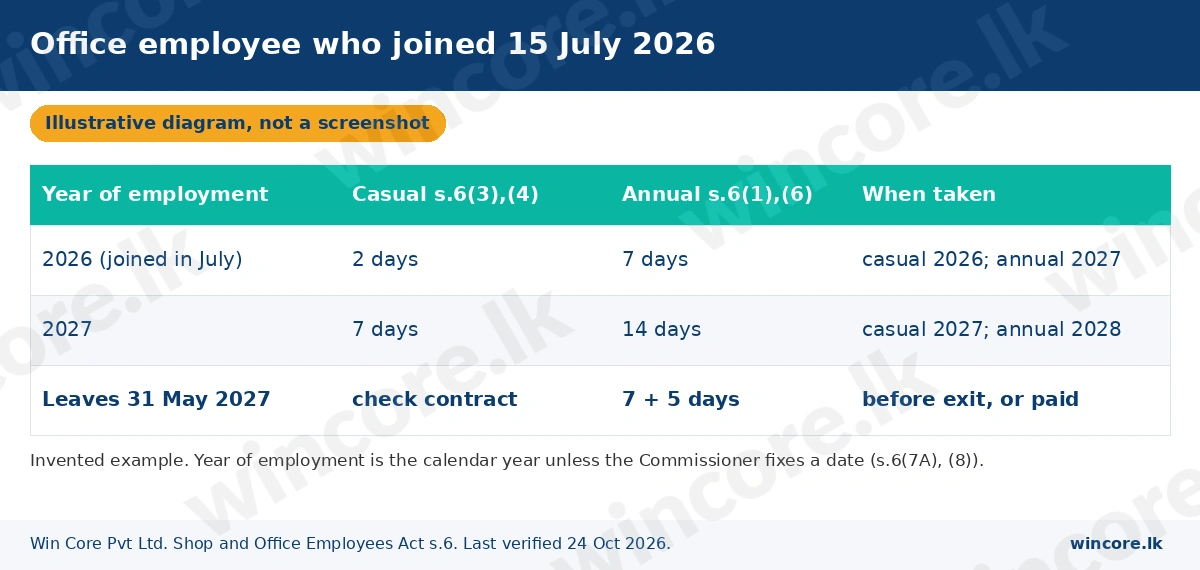
This is an invented example. Hiruni joins the office of a rubber products manufacturer in Colombo as an accounts assistant on 15 July 2026, on Rs 120,000 a month. The firm uses the calendar year, and no Wages Board decision covers her clerical job.
Casual leave for 2026. From 15 July to 31 December she completes two full two-month periods (15 July to 14 September, and 15 September to 14 November). Section 6(4)(a) gives her 2 days, to be taken in 2026.
Annual holiday for 2026. She started between 1 July and 30 September, so section 6(1)(a)(iii) gives her 7 days. Under section 6(2) she takes them in 2027, on agreed days.
2027. She has 7 days of casual leave for use in 2027 and earns 14 days of annual holiday, to be taken in 2028, with at least 7 consecutive.
If she resigns effective 31 May 2027. Section 6(6) entitles her to take, before that date:
- (a) the 7 days for 2026, if not yet taken;
- (b) for 2027, "one day in respect of each complete month, if such period is less than ten months": five complete months, so 5 days.
That is 12 days in total. If her notice period is too short to fit them in, the proviso requires payment instead (see below). How much of her 2027 casual leave survives a mid-year exit is not spelled out, so check the contract.
Leave survives notice, and unused days are paid at exit
Section 6(7) protects leave during notice: "The fact that notice of termination of employment has been given by an employer or a person employed shall not prejudice the right of such person to take before the date of the termination of his service any leave to which such person may be entitled under the preceding subsections" [1].
Section 6(6) covers the holiday due on termination, and its proviso deals with cash: "where any such holiday cannot be allowed by reason that the period of notice of termination of employment is insufficient or the employment is terminated without notice, the employer shall pay full remuneration to such person in respect of each day on which a holiday should otherwise have been allowed."
So at exit the employee takes the days before the last working day, or is paid for each day that could not be given; the days do not lapse. For the rest of an exit, see our employee termination guide.
Weekly holiday, contract terms and leave records
The seven-day week and the weekly holiday
Section 5(1) requires that each person "shall, in respect of each week, be allowed one whole holiday and one half-holiday", with full remuneration "if such person has worked for not less than twenty-eight hours, exclusive of any period of overtime work, during that week" [1].
Section 5(2) says those holidays "shall be allowed either in that week or in the week immediately succeeding". Holidays for four consecutive weeks may be accumulated within the month only "with the prior written sanction of the Commissioner". Days on paid leave count as normal working days for the 28-hour test (s.5(3)). For overtime and hours limits, see our overtime and weekly rest guide.
What a contract may add, and what it cannot take away
Section 70(2) keeps better terms. Where an employee is entitled "under any contract, agreement, award or custom to any rights, or privileges more favourable than those to which he would be entitled under this Act", nothing in the Act lets the employer "withhold, restrict or terminate such rights or privileges" [1].
Section 70(3) strikes down worse terms. Any contract term by which a right under the Act "is in any way affected or modified to his detriment ... shall be null and void in so far as it purports to affect or modify any such right" [1].
So a contract may add things: 21 days of annual leave, separate sick leave, or a cash payment for unused contractual days above the statutory figures. It cannot reduce the 14 days, remove the seven days of casual leave, or forfeit leave at exit. A probation clause cannot cut the statutory figures either; see our probation rules guide.
Leave records
Section 18(b) requires every shop and office to "maintain in the prescribed form and manner, a record of the hours actually worked by each such person, including particulars of all overtime work, and of all holidays and leave allowed to or taken by each such person" [1]. Section 17 requires the employer to give each person, on the date of employment, the prescribed particulars of the conditions of employment.
A simple leave record per employee shows the start date, the first-year scale, casual days taken, annual days earned and taken, and any exit payment under the section 6(6) proviso.
Public holidays and maternity leave
Public holidays under section 7 and maternity leave under Part IA are outside this guide. If annual or casual leave under section 6 falls on a section 5 weekly holiday or a section 7 public holiday, regulation 51 of the 1954 Regulations gives that holiday in addition to the leave [4].
Has anything changed in 2026?
The most recent amending Act we found is the Shop and Office Employees (Amendment) Act, No. 28 of 2024, certified 13 May 2024. It amends sections 10, 66 and 68 and does not touch section 6 [2].
On 8 January 2026, Parliament news reported that the Ministerial Consultative Committee on Labour had approved a regulation under the Act on night work in residential hotels, scheduled for debate on 9 January 2026 [3]. That regulation does not concern leave.
We found no Act or Bill in 2025 or 2026 changing section 6 when we searched parliament.lk, documents.gov.lk and the Department of Labour list of amending Acts on 26 October 2026.
What this means for you
- Confirm each worker is in a shop or office, and check whether a Wages Board decision also covers their trade.
- Give 14 days of annual holiday a year, with at least 7 consecutive. Use the 14, 10, 7 or 4 day scale for the first year.
- Schedule annual holiday in the year after it is earned. The Act gives no carry-forward rule, so set one in the contract.
- Allow up to 7 days of paid casual leave, which also covers ill health. In the first year, this is one day per complete two months.
- At exit, let the employee take the leave due or pay for each day that cannot be given.
- Keep the section 18(b) leave record.
Checklist: documents needed
- Employment contract and leave policy or handbook
- Each employee's start date and job description (to confirm shop or office coverage)
- Any Wages Board decision for the trade, if one may apply
- Leave record under section 18(b) for the current and previous year
- Notice letter and last working day, for any exit
- Medical certificate rule, if your contract has one
FAQ
How many days of annual leave must a shop or office employer give?
Fourteen days with full remuneration for the second and later years of employment, of which at least seven must be consecutive, under section 6(1)(b). The holiday earned in one year is taken in the next year, on days agreed between employer and employee. A contract may give more, but section 70(3) makes any term giving less void.
What does an employee who joined in July get in the first year?
Under section 6(1)(a)(iii), someone who starts between 1 July and 30 September gets seven days of annual holiday for that first year, taken the following year. Casual leave in the first year is one day for each complete two months of service under section 6(4)(a), so a 15 July joiner has two days in that calendar year.
Is there separate sick leave under the Shop and Office Employees Act?
No. Section 6(3) gives up to seven days of paid leave for private business, ill health or other reasonable cause, subject to prescribed conditions. The section does not set a medical certificate rule or extra sick days. A contract may add both, which section 70(2) allows. Check the contract before refusing paid leave.
Can an employer refuse leave during the notice period?
Section 6(7) says notice of termination does not prejudice the right to take leave before the termination date. If the notice period is too short, or there is no notice, the proviso to section 6(6) requires the employer to pay full remuneration for each holiday day that could not be allowed.
Talk to us. To review your leave policy, see our HR services, which list "HR Compliance" and "Employee Handbooks", or book a consultation at our contact page.
WinCore Pvt Ltd
General information on the law as at 26 October 2026, not advice on your position.
Sources and references (4)
- Shop and Office Employees (Regulation of Employment and Remuneration) Act (Chapter 129), ss.5, 6, 17, 18, 37, 68 and 70, Department of Labour Labour Code. https://labourdept.gov.lk/downloads/labour_code/20.pdf . Primary. Amending Acts No. 14 of 2018 (ss.18B, 18I) and No. 28 of 2024 (ss.10, 66, 68) do not change these sections except the s.68 office definition. Accessed 26 October 2026.
- Parliament of Sri Lanka. Shop and Office Employees (Regulation of Employment and Remuneration) (Amendment) Act, No. 28 of 2024 (certified 13 May 2024), ss.2 to 4. https://www.parliament.lk/uploads/acts/gbills/english/6332.pdf . Primary. Accessed 24 October 2026.
- Parliament of Sri Lanka. "Ministerial Consultative Committee approves the Regulation under the Shop and Office Employees (Regulation of Employment and Remuneration) Act", 8 January 2026. https://www.parliament.lk/en/home/parliament-news/view/5013 . Primary (news). Accessed 24 October 2026.
- Shop and Office Employees (Regulation of Employment and Remuneration) Regulations, 1954, regs. 15, 16, 47 and 51, Department of Labour Labour Code. https://labourdept.gov.lk/downloads/labour_code/23.pdf . Primary. Accessed 26 October 2026.
Put these insights to work
WinCore specialists can review your current workflow, document gaps, and build a practical 90-day action plan.
Book a free consultationRecent articles

Continue reading
Explore more WinCore analysis to keep your finance, tax, and compliance roadmap moving.
Employer guide to the Shop and Office Employees framework in Sri Lanka, covering coverage tests, hours, leave, records, and inspection controls.
How to lawfully terminate employees in Sri Lanka: disciplinary inquiries, TEWA consent or approval, compensation, final pay and the six-month tribunal limit.
The 8 and 45 hour limits, the 1954 overtime regulations, the 9-hour cap for women, weekly holidays, Poya pay and Wages Board hours, clause by clause.